One afternoon, after I’d spent twenty minutes explaining why my decisions had been legally and ethically defensible, she asked, “Amanda, are you trying to convince me or yourself?”
I stared at her.
“I don’t know.”
“Then maybe that’s where we start.”
We talked about childhood.
About how I’d learned to read Dad’s moods by the sound of his footsteps.
About the way Mom’s smile changed when company arrived.
About how Justin could insult me at dinner and everyone would laugh, but if I defended myself, I was accused of ruining the evening.
I remembered being seven and earning the highest math score in my class.
I’d brought the paper home folded carefully inside my backpack.
Dad was celebrating Justin’s soccer goal.
He barely looked at my test.
“Good,” he’d said. “Keep it up.”
Then he’d turned back to Justin.
I had told myself that if I earned another perfect score, he’d pay attention.
I spent most of my life operating under that assumption.
One more achievement.
One more promotion.
One more opportunity to prove I deserved a place at the table.
Rebecca asked me what I would have wanted my father to say that day.
The answer came immediately.
“That’s my girl.”
Three words.
I was thirty-two years old, sitting in a therapist’s office, crying because a man hadn’t said three words to me when I was seven.
Healing was not the elegant process I’d imagined.
Some weeks, I felt lighter.
Other weeks, I woke furious about things that had happened fifteen years earlier.
I found myself snapping at friends over small misunderstandings.
I had trouble accepting compliments.
When my new manager praised my work, my first instinct was to explain what I could have done better.
Sometimes I missed my family so badly that I wanted to call Mom and pretend none of it had happened.
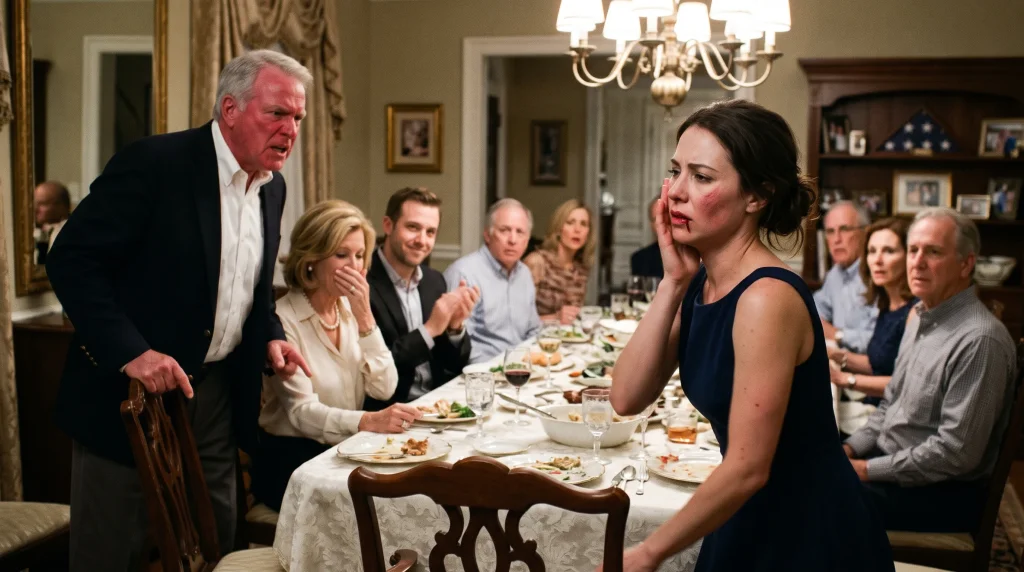
Then I remembered the blood on my dress.
And the way she had laughed.
Six months after the reunion, my mother sent me a letter.
Five handwritten pages.
Her stationery still carried the embossed initials she’d used before the divorce.
The first page was mostly complaints.
She described the humiliation of losing friendships, the financial uncertainty, and the emotional strain of starting over.
She blamed Dad.
Then she blamed me.
Then, somewhere in the middle of page three, the tone changed.
I’ve been thinking about what you said in court.
I stopped reading.
Then continued.
You said you spent your childhood trying to make your father proud. I always thought you were so independent that you didn’t need the kind of encouragement Justin needed.
I put the letter down.
That was one of the explanations she’d used for years.
Justin needed reassurance.
Amanda was strong.
Justin needed opportunities.
Amanda could manage on her own.
It had been a convenient way to give one child everything and call the other child’s deprivation a compliment.
I picked up the letter again.
Looking back, I can see that we often dismissed what mattered to you. I thought I was keeping the family together by avoiding arguments with your father. I didn’t understand how much of that burden I was placing on you.
Then came the line I read several times.
I should have gone after you that night.
I sat very still.
It wasn’t a complete apology.
She still described the investigation as excessive.
Still suggested that things might have been handled privately.
Still wrote about her suffering at greater length than mine.
But she’d acknowledged one thing without immediately blaming me.
She should have gone after me.
For my mother, that was enormous.
I didn’t respond for three weeks.
Not because I wanted to punish her.
Because I needed to decide what I actually wanted.
Finally, I wrote back.
I told her I was glad she was safe.
I acknowledged that the divorce and financial changes must be difficult.
I also told her that I wasn’t ready to resume our old relationship.
If we communicated, it would have to be without insults, pressure, or attempts to make me responsible for Dad’s choices.
I mailed the letter on a Tuesday.
Then I went to work.
There was no dramatic reconciliation.
No tearful embrace.
No guarantee that Mom would change.
But she replied with a short note saying she understood.
For now, that was enough.
My relationship with Aunt Jean developed more naturally.
We began meeting for lunch every few weeks.
Sometimes we talked about the family.
Mostly we didn’t.
She told me about her retirement, her arthritis, the neighbor who kept stealing tomatoes from the community garden.
I told her about work, books, and the cooking class I’d started taking on Wednesday nights.
One afternoon, while we were eating sandwiches at a small café, she said, “I owe you an apology.”
I looked up.
“You already apologized.”



