“Why’d you do that?”
“Because Harold always wanted to see the ocean during a storm.”
I smiled.
“Did you like it?”
“Not particularly. I was freezing.”
We both laughed.
Then she grew quiet.
“But I’m glad I went.”
After we hung up, I sat by my apartment window.
The city was busy below.
A delivery cyclist argued with a cabdriver.
Someone walked a dog wearing a ridiculous yellow raincoat.
Across the street, a couple carried groceries into their building, laughing about something I couldn’t hear.
Ordinary life.
For years, I’d imagined that freedom would feel like a spectacular victory.
My father admitting he was wrong.
My mother finally choosing me.
My brother apologizing in front of the relatives who’d watched him humiliate me.
I’d imagined a moment when everyone would understand what they’d done, and the years of hurt would somehow become worthwhile.
Some of those things happened, at least partially.
Others never did.
Dad faced legal and professional consequences.
Mom began acknowledging her part in our family history, though imperfectly.
Justin finally admitted the jealousy and fear he’d hidden behind his arrogance.
The company lost its place in the family’s identity.
But none of those developments magically gave me the childhood I’d wanted.
I still occasionally wished Dad would call just to ask how my day had gone.
I still felt a pang when I saw fathers celebrating their daughters’ accomplishments.
Sometimes I missed the big holiday dinners, even though I knew how miserable they often made me.
I could acknowledge those feelings without returning to the life that had created them.
My family had spent decades teaching me that loyalty meant absorbing whatever they chose to give me.
I used to believe that walking away would make me selfish.
Now I understood that love without respect isn’t the kind of love I’d been trying so desperately to earn.
The three phone calls I made after that family dinner didn’t give me revenge in the simple, satisfying way I’d imagined while sitting in that hotel room.
They opened investigations, legal proceedings, painful conversations, and consequences I couldn’t control.
They also forced me to examine my own motives.
I hadn’t acted out of pure courage.
Part of me had been furious.
Part of me had wanted my father to feel powerless.
Part of me had wanted everyone at that dinner table to understand how badly they’d failed me.
I’m not especially proud of those feelings.
But I no longer pretend I didn’t have them.
What matters is that I chose to put the evidence in the hands of people who could evaluate it, rather than using it as a weapon in another family argument.
And what they found was bigger than our family.
There were clients who deserved answers.
Employees who deserved better treatment.
People whose financial futures had been affected by decisions made behind closed doors.
My father had always believed that power meant nobody could question him.
He was wrong.
But the most important thing I learned wasn’t about his power.
It was about mine.
For thirty-two years, I thought being a good daughter meant staying quiet, making excuses, and accepting whatever version of myself my family wanted to believe.
The disappointing daughter.
The difficult daughter.
The one who needed to be reminded of her place.
They never really knew the woman I’d become outside that house.
The analyst who’d built a career without their help.
The professional who understood exactly what was wrong with the records she’d found.
The woman who could be terrified and still make a difficult decision.
The daughter who finally understood that sharing someone’s last name didn’t obligate her to protect their misconduct.
I had spent my life waiting for my father to tell me I was worth respecting.
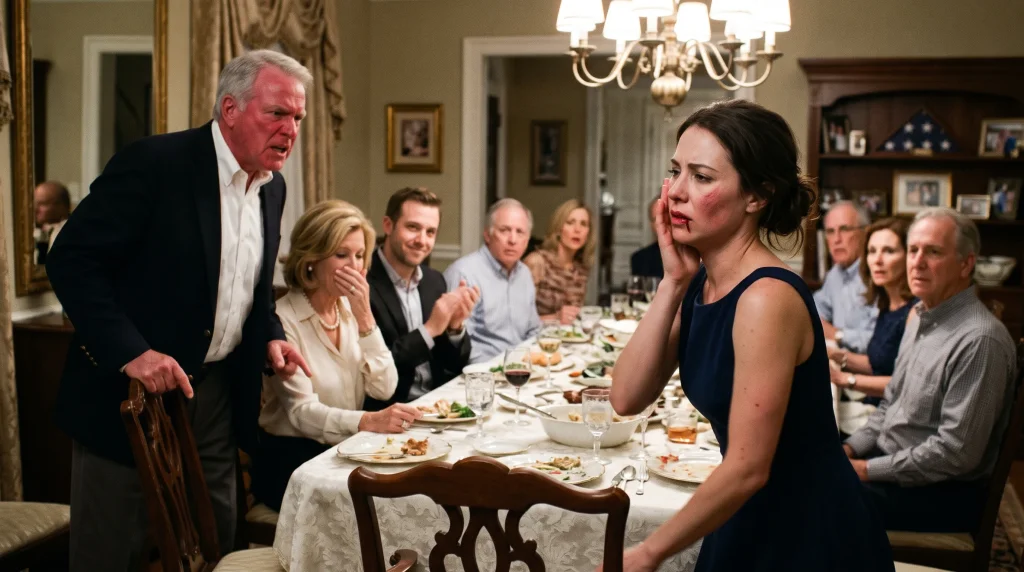
That night at the hotel, with my face swollen and my dress stained with blood, I stopped waiting.
The next morning, three people answered my calls.
And slowly, painfully, my life became my own.
I still have the Gordon name.
I still love people in my family, even when loving them is complicated.
I still wish some things had been different.
But when I look in the mirror now, I no longer see the little girl standing at the edge of a crowded dinner table, hoping someone will finally come to her defense.
I see the woman who walked out.
And this time, I know exactly who she is.



