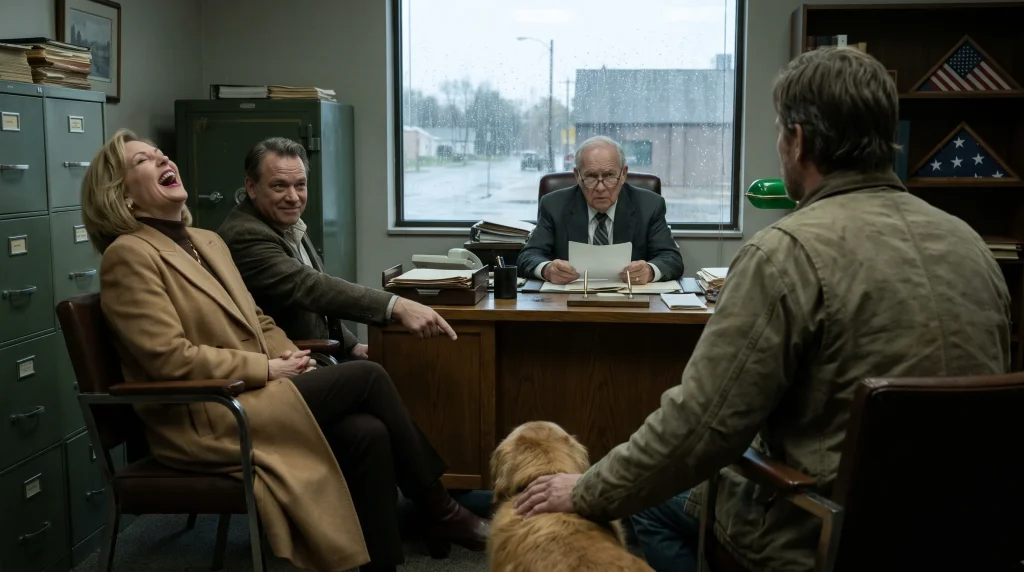
My aunt Brenda started laughing before Grandpa’s lawyer even finished reading the will.
Not a nervous laugh. A real one.
“Well, that figures,” she said, smoothing the sleeves of her expensive camel coat. “The help gets the dog.”
My uncle Gary snorted beside her.
“Fourteen years old and blind? Mitch, do yourself a favor. Put her down.”
Pearl lifted her gray muzzle from my boots when she heard his voice. Then she settled back against my leg.
I was 47 years old, sitting in a lawyer’s office in Mankato, Minnesota, realizing that five years of my life had just been reduced to an old dog nobody else wanted.
Brenda got Grandpa’s house.
Gary got his $340,000 savings account.
And I got Pearl.
I won’t pretend the money didn’t sting.
The lawyer, Arvid Penner, had known my grandfather for fifty years. He was seventy-six, wore glasses that constantly slid down his nose, and kept his office above a hardware store because he said paying rent somewhere fancy wouldn’t make him any smarter.
He’d read the will slowly, pausing between provisions as if he expected somebody to interrupt.
When he finished, he looked at me.
Not at Brenda. Not at Gary.
Me.
“Do you understand what’s been left to you, Mitchell?”
I nodded.
Pearl shifted against my boots.
“Then I’ll need you to sign the acknowledgment of receipt.”
Brenda was already reaching for her purse.
“I assume we can get the house transferred right away,” she said. “There’s a lot to sort through.”
Arvid folded his hands.
“We’ll follow the required process, Brenda.”
“I understand that. I’m just saying there’s no reason to drag things out.”
Gary checked his phone.
“Does the money come as one check, or what?”
Neither of them asked where I intended to live.
I signed the acknowledgment, clipped Pearl’s leash to her collar, and walked out into the October rain.
Grandpa had been dead for seven days.
I was still reaching for my phone every afternoon around four because that was when he liked his coffee.
That habit hurt worse than the will.
Five years earlier, Grandpa had fallen from a stepladder in his garage.
He was eighty-four then, still stubborn enough to insist he could fix his own gutters and still proud enough to hide how badly his vision was deteriorating.
He lay on the concrete floor all night.
The mail carrier found him the next morning after hearing him call through the side door.
By the time I got to the hospital, Grandpa was furious about the ambulance bill.
“I could’ve gotten up eventually,” he told me.
“You were on the floor for fourteen hours.”
“Wasn’t counting.”
The doctor explained that Grandpa couldn’t safely live alone anymore.
Brenda suggested assisted living.
Gary suggested selling the house.
Grandpa said he’d rather sleep in the garage again.
I was working as a machinist at a plant outside Mankato. I had a mortgage, a wife named Lisa, and a fifteen-year-old son, Owen, who was getting pretty good at baseball.
I told myself I’d help Grandpa for a few weeks.
Then a few weeks became several months.
His eyesight got worse. His balance never fully recovered. He needed someone there at night.
I tried juggling work and caregiving, but the plant didn’t operate according to Grandpa’s medical appointments.
One afternoon, my supervisor called me into his office.
“Mitch, you’re a good machinist. But I need somebody who can actually be here.”
I understood.
I resigned the following Friday.
Lisa cried when I told her.
Not because she didn’t care about Grandpa. She did.
But we’d been having problems before his fall, and my decision made every existing problem harder.
“We have a son,” she said. “We have bills.”
“I know.”
“You keep saying that.”
“I don’t know what else to do.”
“That’s the problem, Mitch. You make a decision and then expect the rest of us to figure out how to live with it.”
She wasn’t entirely wrong.
I moved into Grandpa’s spare bedroom, expecting things to settle down.
They didn’t.
Within a year, Lisa and I were divorced.
Owen went with her.
He was sixteen by then, old enough to be angry and young enough to make that anger sound permanent.
“You picked him,” he told me once.
“That’s not what happened.”
“It’s what it feels like.”
I should have listened longer.
Instead, I tried explaining medical appointments and falls and things a sixteen-year-old wasn’t interested in hearing.
Eventually, he stopped returning my calls.
I mailed birthday cards anyway.
I never knew whether he opened them.
Meanwhile, Grandpa and I developed a routine.
I made breakfast. He complained about the toast. I reminded him to take his pills. He accused me of trying to poison him with pharmacy chemicals.
On Tuesdays, I drove him to appointments.



