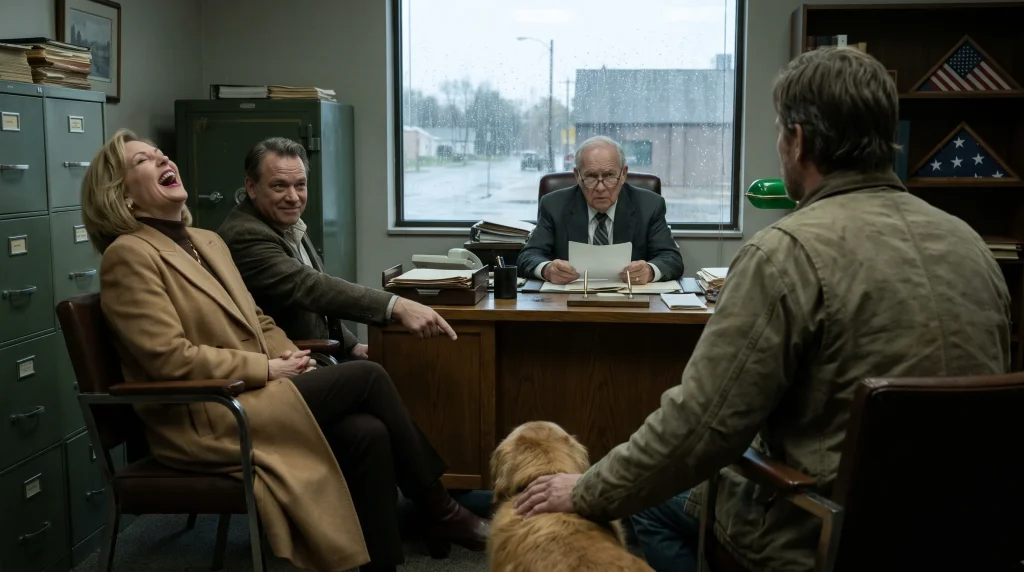
She crawled out from under the table and pressed her forehead against my chest.
I stroked her ears until she stopped shaking.
Then I called Arvid.
He listened without interrupting.
When I finished, he said, “I’d prefer they direct future communications through counsel. I’ll make that clear.”
“Can they take her?”
“Not simply because they want her. You’re her owner under the will, and you’ve been providing appropriate care.”
“What if they try?”
“Then we’ll respond through the proper channels.”
I hesitated.
“Arvid, what if I lose?”
“Which part?”
“The farm.”
There was a pause.
“Mitchell, Walter made his decision for reasons he believed were important. But your responsibility is to Pearl, not to guaranteeing a particular inheritance.”
I looked at her.
“She was mine before I knew about the land.”
“I know.”
“So did Grandpa.”
“Yes,” Arvid said. “He did.”
The next morning, I drove out to the farm.
I hadn’t been there in years.
The gravel road had more potholes than I remembered, and the mailbox leaned at an angle that would have irritated Grandpa.
The farmhouse stood behind a row of old maple trees.
White siding, peeling paint, and a porch facing south.
The barn roof sagged slightly near the west corner.
Beyond it stretched the fields, cut down to stubble after the fall harvest.
I parked the truck and helped Pearl down.
She lifted her nose.
For a moment she stood completely still.
Then her tail started moving.
Maybe she recognized the smell of the fields.
Maybe she just liked the wind.
I walked her along the gravel drive.
The farmer who rented the acreage, Dale Sorenson, spotted us and came over in his pickup.
He was in his sixties, broad-shouldered, with dirt permanently worked into the lines of his hands.
“Mitchell?”
“Hey, Dale.”
He studied me.
“Sorry about Walter.”
“Thanks.”
“He was a good landlord.”
“That surprises me. He complained about everything.”
Dale laughed.
“He complained because he liked talking.”
He looked toward the farmhouse.
“Penner tell you what’s going on?”
“Some of it.”
Dale nodded slowly.
“Walter asked me last spring whether I thought you’d ever come back here.”
I looked at him.
“What did you say?”
“Told him I figured you had enough work looking after him.”
“And?”
“He said, ‘That boy knows how to stay. I wonder if he remembers how to start.’”
I didn’t know what to say.
Dale cleared his throat.
“Anyway, the porch needs a couple boards replaced before winter. If you end up taking over, I know a fella.”
He drove away.
I stood there thinking about Grandpa’s words.
Knows how to stay.
Remembers how to start.
For five years, staying had been my entire life.
I hadn’t thought much about what came afterward.
That afternoon, I did something I hadn’t done in nearly two years.
I sent Owen a message.
Not a long explanation.
Not another birthday greeting.
Just a photograph of Pearl standing on the farmhouse porch, her gray face turned toward the sunshine.
Under it I wrote:
“Grandpa’s old farm. Pearl likes it here.”
My phone showed that the message had been delivered.
No reply.
I put it away.
I didn’t really expect one.
Still, I checked twice before going to bed.
Over the next two weeks, my life narrowed to a peculiar routine.
Pearl and I drove to the diner, the hardware store, the vet, and occasionally the farm.
I kept a notebook of her meals, medication, and appointments because Arvid suggested documenting her care.
I made copies of everything.
If Gary wanted a fight, I intended to arrive with more than good intentions.
At night, I kept the motel curtains closed.
I hated admitting it, but Gary’s threat had gotten under my skin.
A pickup passing slowly through the parking lot made me look up.
An unfamiliar knock made Pearl lift her head.
Once, I woke at two in the morning convinced I’d heard somebody trying the door.
Nobody was there.
I stood in my socks, holding a flashlight, feeling ridiculous.
The next morning, Janice caught me yawning over coffee.
“You look worse than last week,” she said.
“Family stuff.”
She slid a plate of eggs toward me.
“Family can be a full-time occupation.”
“Tell me about it.”
She watched me push my food around.
“Walter ever tell you why he kept that farm?”
“He liked owning land.”
“That too.”
She refilled my cup.
“His father nearly lost it during a bad stretch. Walter spent years paying off what was owed. He told me once he’d rather sell his house than sell an acre.”
I knew bits of that history.
Grandpa had talked about lean years and bank loans.
But I’d never connected it to his stubbornness about the farm.
Janice leaned closer.
“He was proud of you, Mitch.”
I looked down.



