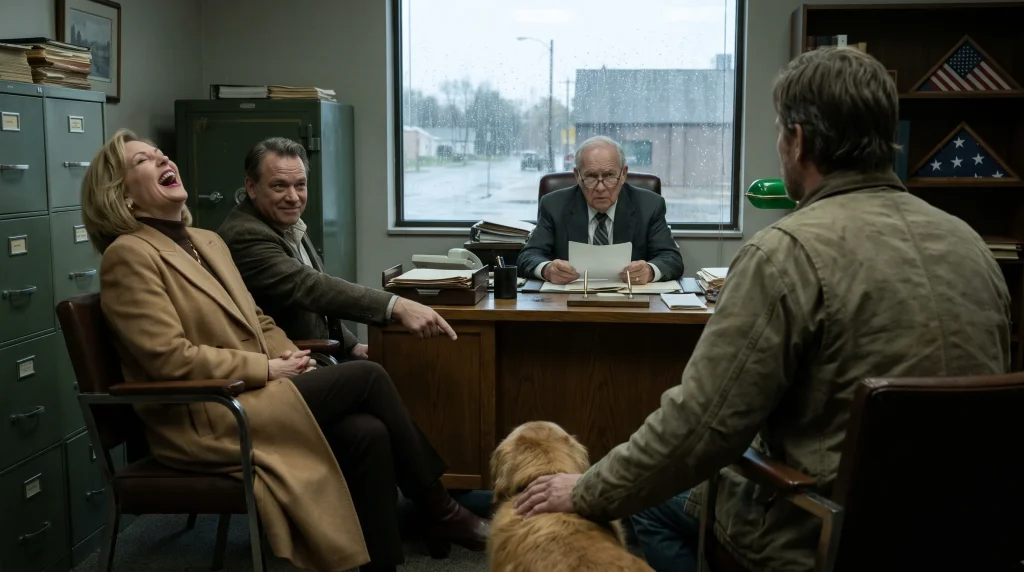
Right where Grandpa’s face was frozen on the screen.
I covered my mouth.
Pearl settled beneath the monitor and rested her chin on her paws.
She waited.
Just as she’d waited at the front door.
Nobody spoke.
Eventually, Whitcomb closed his folder.
He leaned toward Brenda and whispered something.
She shook her head.
Gary stood so abruptly that his chair scraped against the floor.
“This is a setup.”
Arvid remained seated.
“You’re entitled to your opinion, Gary.”
“You think this proves anything?”
“It documents your father’s intentions and his capacity, alongside the other evidence. It doesn’t prevent you from seeking legal advice.”
Gary looked at me.
“You manipulated him.”
I stood.
For the first time in our lives, Gary seemed unsure what I was going to say.
“I spent five years making sure your father wasn’t alone,” I told him. “You could’ve visited whenever you wanted.”
He opened his mouth.
I kept going.
“You didn’t have to agree with me. You didn’t have to like me. But you could’ve shown up.”
His jaw worked.
Then he grabbed his coat and walked out.
Brenda remained seated.
Arvid let the room settle.
Finally, he spoke.
“Pearl has remained in Mitchell’s care through the required period. The veterinary records and other documentation establish appropriate ongoing care. As trustee, I am satisfied that the condition has been met.”
Whitcomb looked at the papers again.
“We’ll need to review the complete file with our clients.”
“Of course.”
Arvid turned to me.
“Mitchell, there are transfer documents to sign.”
I looked at Pearl.
She was still lying beneath the screen.
“Can we leave it on a little longer?”
Arvid followed my gaze.
Then he nodded.
“Certainly.”
For several minutes, we sat quietly while Grandpa’s face remained on the monitor.
Eventually, Brenda stood.
She walked toward Pearl.
I expected her to reach down.
She didn’t.
She just looked at the dog for a long time.
Then she whispered, “He really counted all those calls.”
I knew what she meant.
Grandpa had remembered how often she’d asked about property.
How rarely she’d asked about him.
Brenda turned toward me.
“I shouldn’t have put your things outside.”
“No,” I said. “You shouldn’t have.”
She pressed her lips together.
“I was hurt.”
“So was I.”
She nodded once.
Then she left.
It wasn’t reconciliation.
But it was the first time she’d admitted doing something wrong without immediately explaining why it was somebody else’s fault.
That counted for something.
After Whitcomb departed, Arvid brought out the final documents.
He explained that the trust would transfer the farm to me, subject to the existing agricultural lease and ordinary property obligations.
There would be paperwork, tax considerations, insurance, and decisions about what to do with the farmhouse.
Owning two hundred forty acres didn’t mean I could simply sell everything tomorrow without consequences.
I appreciated that he didn’t treat me like I’d won a lottery.
When he handed me the pen, I hesitated.
“You sure Grandpa wanted this?”
Arvid looked at me over his glasses.
“He spent a considerable amount of time making sure it happened.”
I signed.
Arvid gathered the papers.
Then he said, “Walter left one instruction for me to deliver verbally.”
I waited.
“He said to tell you the farm was on his tab.”
That did it.
I cried.
Not quietly this time.
Arvid passed me a box of tissues without comment.
Pearl came over and pressed her head against my knee.
I sat there holding her while the old lawyer pretended to organize his papers.
A week later, I moved into the farmhouse.
It needed work.
The kitchen faucet dripped. The upstairs bathroom had a cracked window. Two porch boards were soft enough that I replaced them immediately.
The furnace worked after a technician cleaned it and replaced a worn component.
Dale Sorenson helped me find a reliable electrician.
Janice sent over a casserole.
Dr. Mercer recommended rugs for the slippery kitchen floor and a ramp for Pearl’s stiff joints.
For a man who’d supposedly inherited a fortune, I spent an impressive amount of time carrying lumber and worrying about plumbing.
But the house felt right.
Not perfect.
Right.
The first afternoon, I helped Pearl onto the south-facing porch.
She stood there sniffing.
The harvested fields stretched toward the horizon.
A few geese crossed overhead.
Pearl turned in a slow circle, found a warm patch of sunlight, and lay down.
Her tail thumped twice.
I sat beside her.
“Grandpa would’ve liked this,” I said.
She lifted her nose.
For a while, we listened to the wind moving through the dry grass.
I began repairing the farmhouse room by room.
At first, I planned to live there quietly.
Find another machinist job.
Maybe sell a few acres eventually if I needed cash.
The trust was settled, but I still had practical decisions to make.



