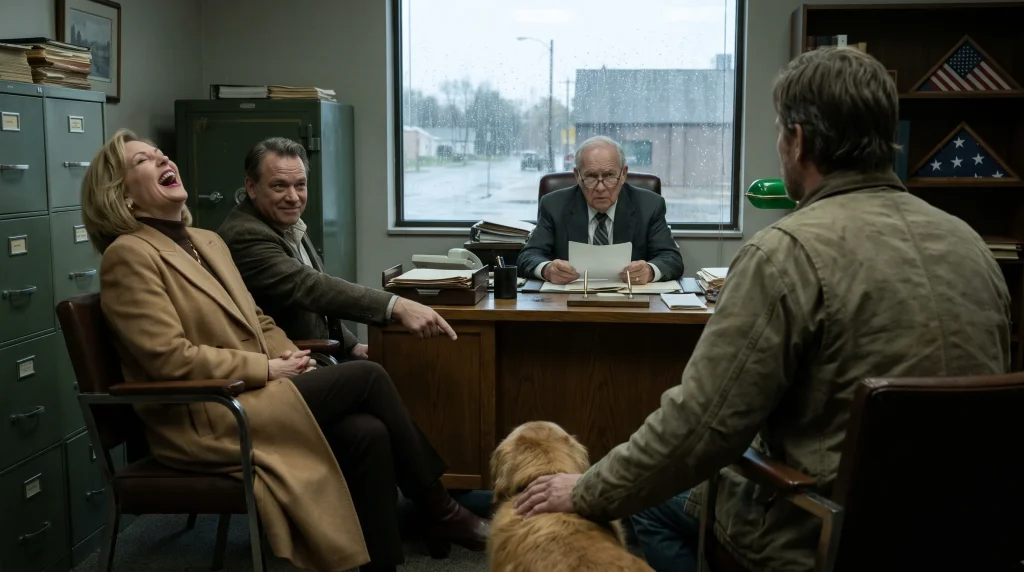
“One or two. Learn what you’re doing before you try to save the whole county.”
I liked her immediately.
Owen came every Saturday.
At first, we repaired fences.
Then we built a ramp.
Then we replaced damaged boards and made a sheltered outdoor area with smooth paths and secure gates.
We argued about measurements.
He accused me of cutting everything an eighth of an inch short.
I accused him of using my tools and putting them back in the wrong drawers.
It felt like family.
Real family.
Not perfect.
But present.
Sometimes we talked about the years we’d missed.
Sometimes we didn’t.
One Saturday, he asked whether I regretted quitting my job.
I thought about it.
“Some days.”
He nodded.
“Do you regret taking care of Grandpa?”
“No.”
“Even though everything else happened?”
I looked across the yard.
“I regret not figuring out how to be there for you too. That’s different.”
He considered that.
Then he went back to tightening a bolt.
I was grateful he didn’t try to make the conversation easier than it was.
Brenda wrote in January.
An actual letter.
Three pages.
She apologized for throwing my belongings onto the porch and acknowledged that she had treated Pearl cruelly by shutting the door.
She also explained that she’d spent years believing Grandpa preferred my mother to his other children.
After Mom died, that resentment had somehow transferred to me.
I read the letter twice.
Some parts sounded defensive.
Some parts sounded sincere.
I wrote back.
I told her I appreciated the apology.
I also told her that trust wasn’t something we could restore with one exchange of letters.
She didn’t argue.
A month later, she sent me a box of my mother’s belongings she’d found while sorting the house.
Inside were photographs, recipe cards, and a faded apron.
There was no note asking for money.
I considered that progress.
Gary never apologized.
He consulted attorneys about challenging the estate planning.
After reviewing the documents and medical evidence, he ultimately chose not to pursue litigation.
He still complained around town that Grandpa had been manipulated.
I heard about it occasionally.
I stopped responding.
The accounting was completed, the debts were applied according to the estate documents, and Gary received his remaining distribution.
Around thirty-one thousand dollars.
Far less than the amount he’d celebrated in Arvid’s office.
I didn’t enjoy imagining his disappointment as much as I thought I would.
By then, I had other things to do.
In March, our first rescue dog arrived.
An elderly beagle named Molly.
Nearly blind, half-deaf, and equipped with the loudest snore I’d ever heard.
Carolyn brought her out in a crate.
“She doesn’t trust people much,” she warned.
Molly emerged slowly.
Sniffed the floor.
Bumped gently into Owen’s boot.
Then sat down and began howling.
Owen looked at me.
“Well, she’s got opinions.”
“Runs in the family,” I said.
Within a week, Molly had claimed Pearl’s old sunny spot on the porch.
I thought that would hurt.
It didn’t.
Not the way I expected.
The porch had never belonged to Pearl because it was empty.
It belonged to her because she’d been happy there.
Seeing another old dog stretch out in the sunlight felt more like sharing than replacing.
By spring, with permits and arrangements in place, we opened a small senior-dog rescue on a portion of the farm.
I called it Walter’s Eyes.
The name confused some people.
Others understood immediately.
We took in dogs that needed more time, more patience, or more care than many households could provide.
Blind dogs.
Deaf dogs.
Old dogs whose owners had died.
Dogs surrendered because medical bills had become impossible.
We worked with veterinarians and local rescue groups to assess each animal and determine what care we could realistically provide.
Not every dog could come to us.
That was one of the hardest lessons.
Carolyn insisted on limits.
“Helping nine dogs well is better than failing twenty,” she said.
She was right.
We built routines.
Food at the same times.
Furniture that stayed in the same places.
Textured mats near doorways.
Gentle voices before touching a dog who couldn’t see.
Owen installed secure gates and fixed whatever broke.
Janice organized a small fundraiser at the diner.
Dale donated hay for bedding in an outbuilding we were converting for storage.
Dr. Mercer volunteered time helping us develop care plans and connected us with affordable veterinary services.
Slowly, the place began to feel less like a project and more like a home.
I still woke some mornings expecting to hear Pearl’s nails clicking across the floor.
Sometimes I reached down beside the bed before remembering she wasn’t there.
Grief didn’t disappear because I found something meaningful to do.
But it became easier to carry.
One Saturday in May, an old black Labrador arrived.



