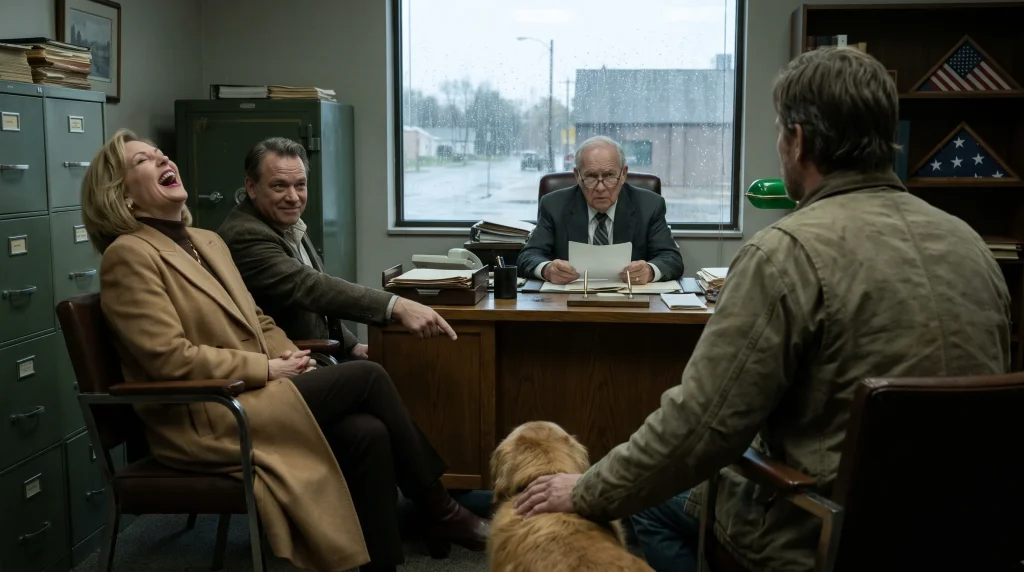
“Gary’s inheritance will be reduced by what he owes,” Arvid said. “The final accounting still has to be completed, but the expected net distribution is around thirty-one thousand.”
I stared at the paperwork.
Gary had been celebrating three hundred forty thousand dollars.
He might receive less than one-tenth of that.
“Does he know?”
“Not yet. He’ll receive the estate accounting.”
I rubbed my face.
“Is any of this going to hold up?”
“The trust was drafted and executed properly. Your grandfather’s capacity was independently documented. But anyone can threaten a legal challenge. That doesn’t mean they’ll win.”
He looked at me carefully.
“Walter wanted you protected. That’s why he did the paperwork years ago, rather than leaving everything to a last-minute will.”
I glanced at Pearl.
She’d found a patch of sunlight beneath the window and was lying there with her nose against the baseboard.
“Does this mean I’m rich?”
Arvid gave me a peculiar look.
“It means you may soon own a valuable farm. That’s not the same as having two million dollars in your checking account.”
“Good. Because my checking account has four hundred and twelve dollars.”
He actually chuckled.
Then he became serious.
“Mitchell, until the thirty days are complete, you need to keep Pearl safe. Continue her normal veterinary care. Keep records. And please don’t discuss the trust with anyone who doesn’t need to know.”
“Why?”
“Because once your relatives receive the accounting, I expect they’ll have questions.”
He was right.
But before they did, I had questions of my own.
Mostly about Grandpa.
I remembered him sitting at the kitchen table with a magnifying glass, writing carefully while I was at the grocery store.
I remembered him asking whether Pearl had eaten.
I remembered how often he touched the dog’s collar near the end.
And I remembered his favorite joke.
Put it on my tab.
Maybe he’d been doing exactly that.
Keeping track.
Not of what he owed me.
Of what he thought everyone owed one another.
I left Arvid’s office carrying copies of the trust documents in a manila envelope.
Outside, the rain had stopped.
I drove to the diner on Front Street because I hadn’t eaten since the previous morning.
Pearl waited in the truck while I went inside to order takeout.
The waitress, Janice, had known Grandpa since before I was born.
She took one look at me and said, “You look terrible.”
“Thanks.”
“Coffee?”
“Please.”
She poured a cup.
“How’s that dog doing?”
“Better than me.”
“Walter loved that animal.”
“I know.”
Janice leaned against the counter.
“He used to bring her here when she was a puppy. Sat outside with a cheeseburger and fed her half the bun when he thought I wasn’t looking.”
I smiled despite myself.
“He kept doing that at home.”
She looked at the truck through the window.
“You got somewhere to stay?”
“Found a motel.”
Her expression changed.
“You’re kidding.”
“No.”
She didn’t ask for details.
Small towns are good at two things: knowing when something has happened and pretending they don’t already know the details.
Janice packed my breakfast and added a plain hamburger patty for Pearl.
When I tried paying for it, she pushed my hand away.
“Tell Walter I said he owes me one.”
Then she stopped.
Her face softened.
“Sorry, honey.”
“It’s okay.”
I took the food outside.
Pearl ate her hamburger in three enormous bites.
For the first time since the funeral, I laughed.
The next few days were strangely ordinary.
I still needed to feed the dog.
I still had laundry.
My truck still needed gasoline.
And I still had to figure out how to survive while a trust worth more money than I could imagine waited for a calendar to turn.
Arvid arranged for the trust to cover reasonable temporary housing and veterinary expenses related to Pearl’s care.
He was careful about explaining what could be reimbursed and what couldn’t.
“Walter wanted you supported,” he said. “Not handed a blank check.”
That sounded fair.
I moved into a slightly cleaner extended-stay motel with a kitchenette.
The carpet was ugly, but the heater worked.
Pearl liked it because the room had fewer corners.
I called her veterinarian, Dr. Ellen Mercer, and scheduled an examination.
She’d treated Pearl for years.
When she heard Grandpa had died, she sat quietly for a moment.
“He was devoted to her,” she said.
“He was.”
“And how are you doing?”
I gave my usual answer.
“Fine.”
She looked at me over her glasses.
“That wasn’t a medical question, Mitch.”
I changed the subject.
Dr. Mercer examined Pearl, checked her heart, and confirmed that she was elderly but reasonably stable.
Her joints were stiff. Her hearing wasn’t what it had been. She needed medication for arthritis and a consistent routine.



