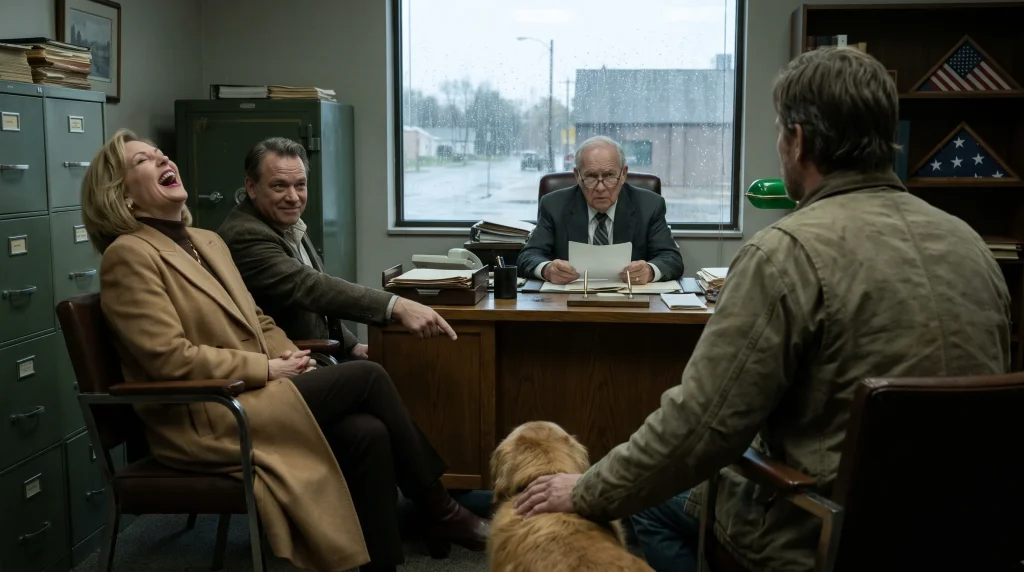
I sat at the table while she retrieved the box according to the bank’s procedures.
Then she left me alone.
Inside was one envelope.
Nothing else.
On the front, in Grandpa’s enormous handwriting, were the words:
“Open when Pearl is gone.”
I stared at it.
For a moment, I didn’t want to know.
The trust had already explained the practical mystery.
The farm was mine.
Gary and Brenda had been confronted with Grandpa’s intentions.
Owen had come back.
What else could Grandpa possibly have left?
I opened the envelope.
Inside was a single sheet of paper.
His handwriting was even shakier than in the first note.
“Mitch,
If you’re reading this, Pearl finally went home.
I hope it was peaceful.
I worried about her every day, even when I was too sick to say so.
I worried about you too.
You spent five years looking after an old man who wasn’t always pleasant and a dog who couldn’t see.
I know what it cost.
I wish I could give you those years back.
I can’t.
But I can give you somewhere to start again.
The land is yours because I trust your hands more than I ever trusted anybody’s promises.
And there’s something I need you to understand.
Pearl was never really your inheritance.
You were hers.
She spent her whole life knowing where home was because somebody loved her enough to stay.
I wanted you to have that too.
Don’t spend the rest of your life paying for the time you gave me.
Go live, son.
And when you find somebody who needs a little help getting home, remember there’s always room for one more.
Love,
Grandpa.
P.S. If the roof still leaks over the back bedroom, Dale knows a good roofer. Don’t let him talk you into replacing the whole thing.”
I read the letter twice.
Then I folded it carefully.
I didn’t cry right away.
I sat there thinking about his hands.
The same hands that had planted corn, repaired tractors, lifted my mother onto his shoulders, and held Pearl in a snowstorm.
Those hands had shaken so badly near the end that he could barely sign his name.
Yet he’d used them to sew a note into a dog collar.
Not because he wanted to make a clever joke.
Because he wanted to be certain I’d find it when I needed him.
I carried the envelope to my truck.
Then I sat in the parking lot for nearly an hour.
Eventually, I called Arvid.
“Found the letter,” I said.
“I thought you might.”
“Did you read it?”
“No. Walter asked that it remain private.”
I looked at the folded paper.
“He told me not to waste the rest of my life.”
Arvid was quiet.
Then he said, “That’s good advice.”
“I don’t know what to do with the farm.”
“You don’t have to decide everything today.”
I watched a woman help an elderly man out of a car near the bank entrance.
He leaned heavily on her arm.
She waited patiently while he adjusted his coat.
“Grandpa said something about helping others get home.”
“That sounds like him.”
I hesitated.
“Arvid, do you think I could use part of the farm for dogs?”
“What kind of dogs?”
“Old ones. Blind ones. Dogs nobody wants.”
He considered that.
“You’d need to look into zoning, insurance, veterinary arrangements, and whether the property is suitable. The agricultural lease also needs to be respected.”
“I know.”
“It’s possible, though. If you approach it properly.”
I looked at Grandpa’s letter.
“Then maybe I’ll find out.”
That winter, I did.
Not quickly.
Not easily.
I met with the county zoning office.
I talked to Dr. Mercer about appropriate care for senior dogs.
I learned more than I ever expected about kennel requirements, sanitation, liability coverage, and nonprofit organizations.
I also learned that good intentions don’t pay veterinary bills.
The farm produced rental income, but I wasn’t interested in treating the land like an endless source of cash.
Dale still needed his fields.
I needed the house.
And any rescue operation would need a realistic budget.
Dr. Mercer introduced me to a woman named Carolyn who volunteered with a regional animal rescue.
She was sixty-seven, blunt, and unimpressed by sentimental speeches.
“Everybody wants to save old dogs,” she told me. “Until the first one needs six hundred dollars’ worth of dental work.”
“I understand.”
“No, you don’t. But you can learn.”
She spent an afternoon walking around the farmhouse and barn.
She pointed out hazards I hadn’t noticed.
Loose wire.
Uneven ground.
Places where a blind dog could fall.
She also pointed out things that would work.
The enclosed yard.
The level section near the south porch.
The quiet surroundings.
“You could start small,” she said.
“How small?”



