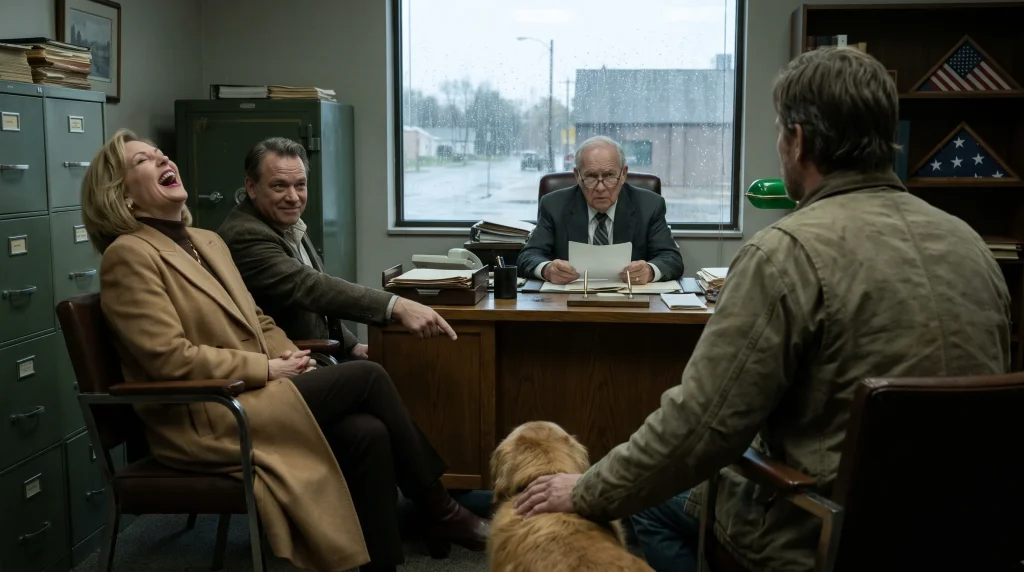
“He was also the most stubborn man I ever represented.”
Arvid stood and walked to an old green safe behind his desk.
He turned the combination slowly.
Inside were several envelopes, a metal cash box, and a photograph of a fishing boat.
He removed a thick folder.
Before opening it, he looked at Pearl.
“She looks comfortable.”
“She’s probably more comfortable than I am.”
“I imagine so.”
He sat down.
“Mitchell, how much do you know about your grandfather’s farm?”
I shrugged.
“He rented the fields. Somebody grows corn out there. The farmhouse has been empty for years.”
“How much land?”
“Two hundred acres? Maybe more.”
“Two hundred forty.”
I nodded.
Grandpa had farmed that land for half a century before retiring.
I’d visited as a kid. There was an old red barn, a gravel driveway, and a farmhouse with a south-facing porch.
I knew the property had value.
I assumed it had already been included in the estate.
“Was it sold?” I asked.
“No.”
“Then why wasn’t it mentioned yesterday?”
“Because it isn’t part of the probate estate.”
Arvid opened the folder.
“Walter transferred the property into a trust several years ago. I serve as trustee.”
He slid a document toward me.
At the top were the words:
THE PEARL TRUST.
I almost laughed.
“Grandpa named a trust after his dog?”
“He did.”
“Why?”
“Because he believed Pearl would tell him something his children wouldn’t.”
Arvid explained that the farm remained legally owned by the trust.
An independent appraisal, completed several months earlier, valued the property at approximately $2.1 million.
I stared at him.
“Two million?”
“Approximately. Land values fluctuate, and there are expenses associated with the property. But yes.”
For a moment I thought he was describing somebody else’s life.
Two million dollars was an amount I associated with factory equipment, not my grandfather’s muddy fields.
“What does that have to do with me?”
Arvid turned another page.
“The trust directs me to transfer the property to you if certain conditions are satisfied.”
“What conditions?”
“You must voluntarily accept responsibility for Pearl and remain her primary caregiver through the thirtieth day following the reading of the will.”
I looked down at her.
She was sniffing the leg of Arvid’s desk.
“And if I don’t?”
“If you refuse her, abandon her, or deliberately arrange for her to be euthanized without a legitimate veterinary need during that period, the trust provides for the property to be sold and the proceeds distributed to the county animal shelter.”
I sat back.
Grandpa had effectively made a dog the deciding factor in a two-million-dollar inheritance.
It sounded ridiculous.
It also sounded exactly like him.
“Why thirty days?”
“Walter wanted enough time for a choice to become a responsibility. Taking her home for one afternoon wouldn’t have told him much.”
“But Pearl’s old. What if she gets sick?”
“Then you obtain appropriate veterinary care. The documents address that. You aren’t required to prolong suffering or refuse medically necessary treatment.”
I was relieved to hear it.
I was also irritated.
“Why didn’t he just tell me?”
Arvid folded his glasses.
“Because if Walter offered you the farm in exchange for caring for Pearl, he wouldn’t know whether you wanted the dog or the land.”
“He already knew I loved her.”
“Yes.”
“Then why test me?”
Arvid waited a moment.
“I asked him that.”
“What did he say?”
“He said he knew you would take her. What he didn’t know was whether the others would finally understand why that mattered.”
I looked at the documents.
There were dates, signatures, notarized pages, and paragraphs written in language that made my eyes ache.
“Was he angry with them?”
“Disappointed would be closer.”
I thought about Brenda’s laughter.
Gary’s suggestion that Pearl be put down.
The garbage bags on the porch.
“Did Grandpa know they’d do that?”
“He expected they might behave badly. I don’t believe he anticipated every detail.”
“Brenda changed the locks yesterday.”
Arvid frowned.
“That was premature. She doesn’t have authority to treat the property as personally hers just because she’s named in the will.”
“She told me it was her house.”
“She’s mistaken about the timing.”
He made a note.
“We’ll address that separately.”
I almost told him not to bother.
Then I remembered my mother’s photo albums sitting in the rain.
“Could you at least make sure she doesn’t throw away anything else?”
“Yes.”
Arvid returned to the folder.
“There’s something more you should understand.”
He explained that the savings account named in the will was subject to the estate’s obligations and Grandpa’s documented loans to Gary.
For twenty-two years, Grandpa had kept signed promissory notes.
Every check.
Every repayment agreement.
Every time Gary promised to settle up after the next business deal.
The outstanding balance was approximately $309,000.



