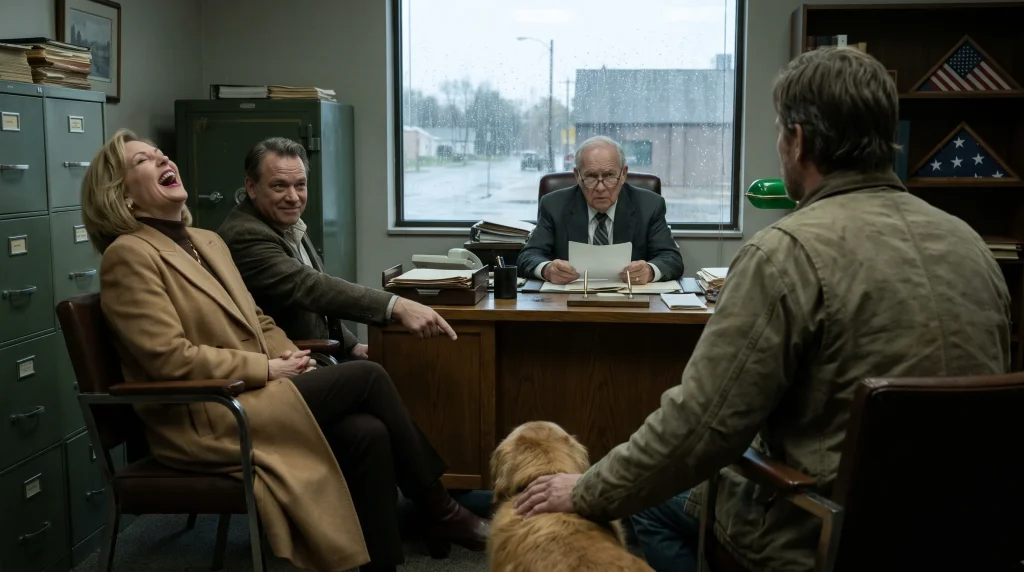
On Fridays, I washed the bedding.
When his hands began shaking badly enough that he couldn’t manage a spoon, I fed him.
He hated that most of all.
“Put it on my tab, Mitch,” he’d say whenever I wiped his chin.
That was his running joke.
Everything went on his tab.
The groceries, the laundry, the trips to Rochester, the nights I spent awake because he was coughing too hard to sleep.
Sometimes I laughed.
Sometimes I wanted to throw the damn tab away.
People like to talk about caregiving as if it’s one long demonstration of patience and love.
It isn’t.
Sometimes it’s standing in a pharmacy line behind twelve people while your father-in-law calls to ask why you haven’t returned his hedge trimmer.
Sometimes it’s discovering you’ve washed the same sheets three times in forty-eight hours.
Sometimes it’s snapping at an old man because he asks for more salt, then feeling ashamed when he apologizes.
Grandpa and I had those days.
We also had good ones.
He told stories about farming before combines had air-conditioning, about the winter of 1965, and about my grandmother burning a Thanksgiving turkey so thoroughly that they ate sandwiches instead.
He liked watching old westerns, even after he could barely see the screen.
He could identify actors by their voices.
And he loved Pearl.
She was a golden retriever with a white face, a thick tail, and an unfortunate habit of stealing bread from the kitchen counter.
Grandpa had brought her home as a puppy fourteen years earlier.
When his vision failed, hers followed.
The veterinarian said it was age-related deterioration. There wasn’t much to be done beyond keeping her surroundings familiar and making sure she didn’t hurt herself.
Grandpa thought the arrangement was funny.
“Two blind old fools,” he’d say, scratching behind her ears. “Good thing we’ve got Mitch.”
And we managed.
Pearl memorized the house.
She knew where the furniture stood, which floorboards creaked, and how many steps led from the porch to the yard.
She could hear my truck long before I turned into the driveway.
Every evening, she waited beside the front door for Grandpa to say, “There’s my girl.”
One January night, during a blizzard, Pearl slipped through the back door while I was bringing in firewood.
I searched the yard for an hour.
Then the neighboring fields.
By midnight, the snow was coming sideways.
I wanted to call the sheriff’s department.
Grandpa put on his coat.
“Where are you going?” I asked.
“To get my dog.”
“You can barely see the steps.”
“Then you’d better make sure I don’t fall.”
He stood on the porch calling her name.
Over and over.
“Pearl! Here, girl!”
His voice grew hoarse.
I begged him to come inside.
He wouldn’t.
Nearly two hours later, I saw movement beyond the fence.
Pearl came staggering through the snow, her fur packed with ice.
She crossed the yard toward Grandpa’s voice.
He got down on his knees and wrapped both arms around her.
I’d seen that man break his wrist, lose his wife, and bury his eldest daughter without crying in front of anybody.
But that night he cried into Pearl’s wet fur.
“She walked home, Mitch,” he whispered.
I never forgot it.
Neither, apparently, did he.
Brenda and Gary remembered Grandpa differently.
Brenda was his youngest child, sixty-one, living in Minneapolis with her husband, Richard.
She’d spent years insisting Grandpa should sell his house and move somewhere with professional caregivers.
Sometimes her arguments were reasonable.
His house needed repairs. The winter sidewalks were dangerous. I wasn’t medically trained.
But there was always another question tucked behind her concern.
“Has Dad decided what he’s doing with the property?”
Gary, fifty-eight, had spent most of his adult life running businesses that never quite worked.
A landscaping company. A used-car operation. A contracting partnership that ended badly.
Grandpa had helped him financially more times than I could count.
Gary always had a reason.
A delayed payment.
An unreliable partner.
A customer who disappeared.
He also had a way of talking that made refusing him feel unreasonable.
“Come on, Dad. You know I’m good for it.”
Grandpa usually wrote the check.
I thought it was because he couldn’t bear watching his son struggle.
Only later did I understand how carefully he kept track of those checks.
The last Christmas we spent together, Brenda arrived carrying a bakery pie and a list of suggestions about selling the house.
Gary came late and complained that somebody had parked too close to the driveway.
Pearl was sleeping in front of the stove.
Gary stepped around her, then apparently decided she was taking up too much room.
He nudged her hard with his shoe.
She yelped and scrambled away.
“Watch where you’re lying,” he muttered.
I’d been standing in the kitchen doorway.



