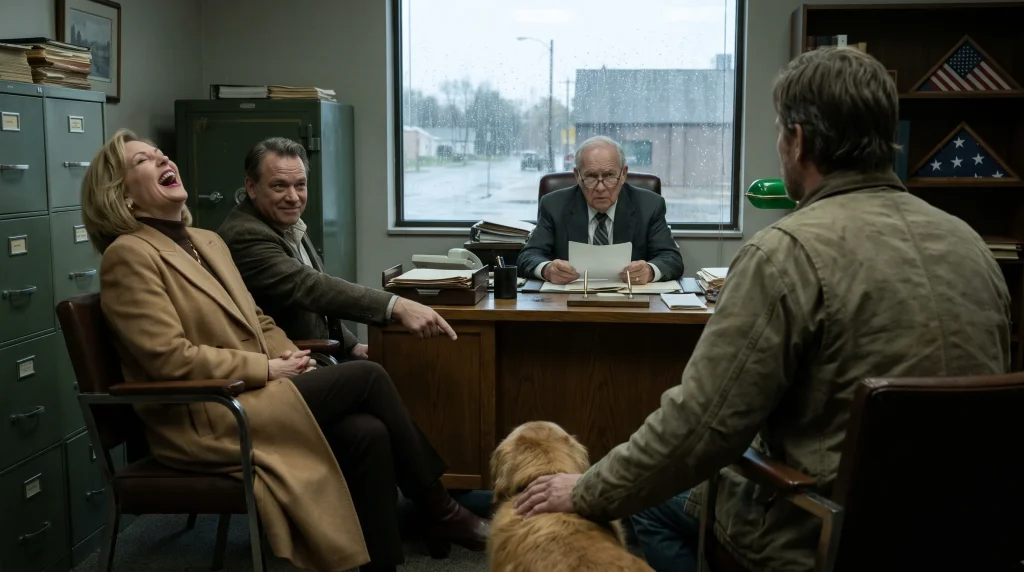
“Don’t do that again.”
Gary looked up.
“Good grief, Mitch. I barely touched her.”
“She’s blind.”
“I know she’s blind.”
Grandpa was in the next room.
I assumed he hadn’t heard.
He said nothing.
A few weeks later, he began asking questions.
Not about the house or the money.
About Pearl.
He asked Brenda during a phone call.
“If something happens to me, would you take her?”
Brenda sighed loudly enough that I heard her from the kitchen.
“Dad, I have white carpeting. And Richard’s allergic to dogs.”
Grandpa said he understood.
He asked Gary the following Sunday.
Gary didn’t hesitate.
“She’s ancient, Dad. You’d be doing her a kindness putting her down.”
Finally, Grandpa asked me.
We were sitting on the porch, Pearl lying between us.
“Would you take her, Mitch?”
I looked at him.
“She’s already mine, Grandpa. She just doesn’t know it yet.”
He nodded.
Then he changed the subject and asked whether we had any canned peaches.
I didn’t think much about that conversation until the night I opened Pearl’s collar.
By then, I was lying on a motel bed in wet jeans, with sixty pounds of damp golden retriever pressed against my thigh.
Brenda had changed Grandpa’s locks before I could collect my belongings.
My tools, clothes, and my mother’s old photo albums had been stuffed into black garbage bags and left on the porch.
October rain soaked through everything.
“You lived here rent-free for five years,” Brenda told me through the screen door. “Don’t act like you got nothing.”
I wanted to tell her that living with a dying man wasn’t free.
I wanted to ask why she’d been in such a hurry.
Instead, I loaded the truck.
Pearl had climbed out and made her way up the porch steps.
She pressed her nose against the front door.
Her tail began moving.
She was waiting for Grandpa.
Brenda watched through the screen.
Then she closed the inside door.
I carried Pearl back to the truck while she kept turning toward the house.
At the motel, the room smelled like cigarettes and pine cleaner.
The television had a purple stripe down one side. The heater rattled whenever it started.
Pearl wouldn’t settle.
Around midnight, she began scratching at her collar.
I took it off, thinking the leather was irritating her.
That was when I noticed the crooked stitches along the inside.
Someone had sewn fishing line through the leather.
The seam was fresh enough that the thread hadn’t darkened.
Grandpa’s hands had shaken badly near the end.
His eyesight had almost disappeared.
But those uneven stitches looked exactly like something he might have managed with a magnifying glass and a great deal of stubbornness.
I took my pocketknife from the nightstand and cut the thread.
A folded piece of wax paper slipped into my hand.
Inside was a small brass key and a note written in enormous, shaky letters.
The first line read:
“Mitch, it was a test.”
I sat perfectly still.
Pearl rested her chin on my knee.
I unfolded the rest.
“If you’re reading this, you took her.
You passed.
They didn’t.
Call Arvid.
Tell him Pearl walked home.
The key is for later.
Not until Pearl is gone.
Love, Grandpa.”
I read it twice.
Then a third time.
I didn’t understand what I’d passed.
I didn’t know what the key opened.
But suddenly I remembered Grandpa running his fingertips along Pearl’s collar every evening during his final week.
I’d thought he was saying goodbye.
Maybe he’d been checking the stitches.
Maybe he’d been waiting to see whether somebody would discover what he’d hidden.
I looked at the little brass key.
A paper tag was tied to it with faded string.
It carried the name of a bank downtown.
I could have driven there the next morning and demanded to know what it opened.
Instead, I put the key back in the wax paper.
Grandpa had asked me to wait.
Whatever else had happened, I could give him that.
At eight the next morning, I returned to Arvid Penner’s office.
Pearl came with me.
Arvid was sitting behind his desk, eating toast over a legal pad.
He looked up when I entered.
“Morning, Mitchell.”
I stood there holding the folded note.
“Pearl walked home.”
For the first time in all the years I’d known him, Arvid smiled.
Not broadly.
Just enough to change his whole face.
“Well,” he said. “Walter was right.”
He motioned toward a chair.
“Sit down, son. We have some things to discuss.”
I didn’t sit.
“Did you know about this?”
Arvid looked at the note.
“I knew Walter intended to leave you instructions. I didn’t know exactly how he planned to get them to you.”
“He sewed it into her collar.”
“That sounds like Walter.”
“He could barely see.”



