Chapter 1 – The Snap
The sound of snapping plastic and ripping copper wire sounded like a gunshot in the quiet morning air of Whispering Pines.
I didn’t flinch. I didn’t shout. I didn’t even spill a single drop of my black coffee.
Sitting at my mahogany desk in my second-floor home office, bathed in the soft glow of four 42-inch ultra-high-definition monitors, I simply tapped the spacebar on my mechanical keyboard. The rhythmic clack froze the frame instantly.
On Screen 2, the image had vanished into a cascade of gray static and a glaring red banner that flashed: SIGNAL LOSS — CAMERA 02 (FRONT PORCH EAST).
On Screen 1, however, the picture was crystal clear. It was rendered in razor-sharp, uncompressed 4K resolution at sixty frames per second.
There stood Renata Cross.
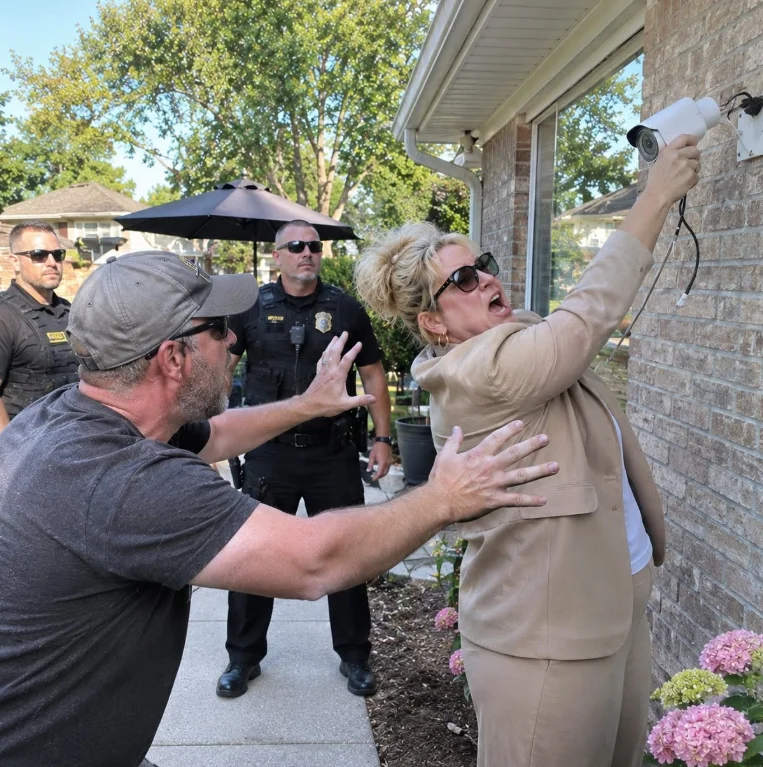
She was fifty-four years old, clad in a pristine, tailored beige linen pant-suit that screamed country club lunch, complete with oversized designer sunglasses perched on her nose and her stiff, blonde hair styled into an immovable helmet. Her face was contorted into a mask of pure, unadulterated venom. Her manicured hands were wrapped tightly around the shattered white housing of my Reolink turret camera, dangling loose black and red power wires like trophies from a fresh kill.
She actually looked proud of herself. Her chest was heaving with exertion, her lips curled into a victorious, vindictive smirk. She stood on the edge of my flowerbed, her two-hundred-dollar loafers crushing my freshly planted pink hydrangeas, holding the broken piece of hardware in front of her like the severed head of an enemy general.
“Got you, you arrogant prick,” she muttered aloud.
She had no idea that the directional microphone on Camera 01, tucked discreetly under the deep soffit of my roofline fifteen feet to her left, picked up every single syllable with horrifying fidelity. She had no idea that the high-gain microphone could hear the frantic rustle of her linen jacket, the sharp crunch of mulch beneath her heels, and the satisfied hiss of her breath.
Renata looked up at the empty mounting plate screwed into the brick wall. A couple of jagged plastic anchors and shredded raw wire hung limp against the mortar. She dusted off her lapel with one hand, tucked the shattered camera under her arm like a clutch purse, and adjusted her sunglasses. She turned on her heel and strutted down my paved driveway toward her immaculate two-story colonial directly across the street.
She honestly thought she had won.
She believed that if she killed the camera, she killed the memory.
She didn’t know who I was. To her, I was just Victor Vance, the quiet, annoying forty-two-year-old bachelor who had moved into Whispering Pines eight months ago and refused to bow down to her petty suburban reign. To her, I was just an IT guy who spent too much time behind closed blinds and ignored her unsolicited lawn-care advice.
She had no clue that for twenty-two years, I had designed fail-safe industrial networks and surveillance infrastructure for government facilities, offshore oil rigs, and secure financial datacenters.
I didn’t just screw a couple of wireless baby monitors into my siding like the rest of the neighborhood. I built fortresses.
My house didn’t have fourteen independent cameras. It had an interlocking, synchronized mesh network.
Every inch of my property was covered by at least two overlapping optical fields of view. The camera Renata had just ripped off the wall had been transmitting to an encrypted local Network Video Recorder (NVR) hidden in a fireproof server rack in my basement. Simultaneously, the camera had an internal high-endurance micro-SD card writing raw video directly to flash storage inside the housing she was currently carrying away.
Even better, every millisecond of footage was routed through a redundant gigabit fiber line to two separate off-site cloud archives in Northern Virginia and Oregon. And if she had thought to cut my fiber line, the system would have switched seamlessly to an enterprise-grade dual-SIM cellular failover before a single frame dropped.
The moment her manicured fingers touched the camera body, my system had already calculated the vibration spike, tagged the incident as a physical tamper alert, locked the buffer, and mirrored the preceding thirty seconds of video to three independent backup drives.
Before the wires had even separated from the terminal block, the footage of Renata Cross committing felony property destruction had already left my house, bounced off three orbital satellites, and settled safely into an immutable, timestamped cloud repository.
I took a slow sip of my coffee, feeling the rich, bitter heat coat my throat.
“Checkmate, Renata,” I whispered into the quiet room.
I reached for my desk phone and dialed three digits: 9-1-1.
“County Emergency Services, what is the address of your emergency?” a calm dispatcher answered within two rings.



