“Three things,” I said, ticking them off on my fingers. “First, the immediate vacating of all outstanding administrative liens and violation fines issued by Renata Cross over the past four years. Second, the appointment of an independent, court-supervised financial trustee to manage the HOA accounts until a general election can be held. And third, the immediate seizure of all assets owned by Crestline Holdings LLC, Verdant Crest LLC, and Renata Cross’s personal real estate holdings to be placed into a court-ordered victim restitution fund.”
Dr. Patel’s eyes widened. “Can the judge do that? Without a full trial?”
“Under the state Racketeer Influenced and Corrupt Organizations Act, yes,” I replied with a thin smile. “When there is clear, uncontradicted evidence of systematic property theft and fraudulent real estate conveyances, the court has the statutory duty to preserve the res—the stolen assets—before they can be dissipated or moved offshore.”
I looked out the window.
Across the street, federal agents were loading the last of the black file boxes into the forensic van.
Renata’s immaculate Lexus was being winched onto the bed of a flatbed tow truck, its vanity plate PRZ-VP1 gleaming under the midday sun like a tragic joke.
A tow operator in high-visibility orange hooked heavy steel chains around the front axle, the hydraulic winch groaning as the luxury vehicle was hauled up the steel ramp.
Two doors down, Mrs. Gable was standing on her porch, her hand shading her eyes against the glare. Beside her stood three other neighbors, their arms crossed, watching the tow truck pull away with quiet, solemn satisfaction.
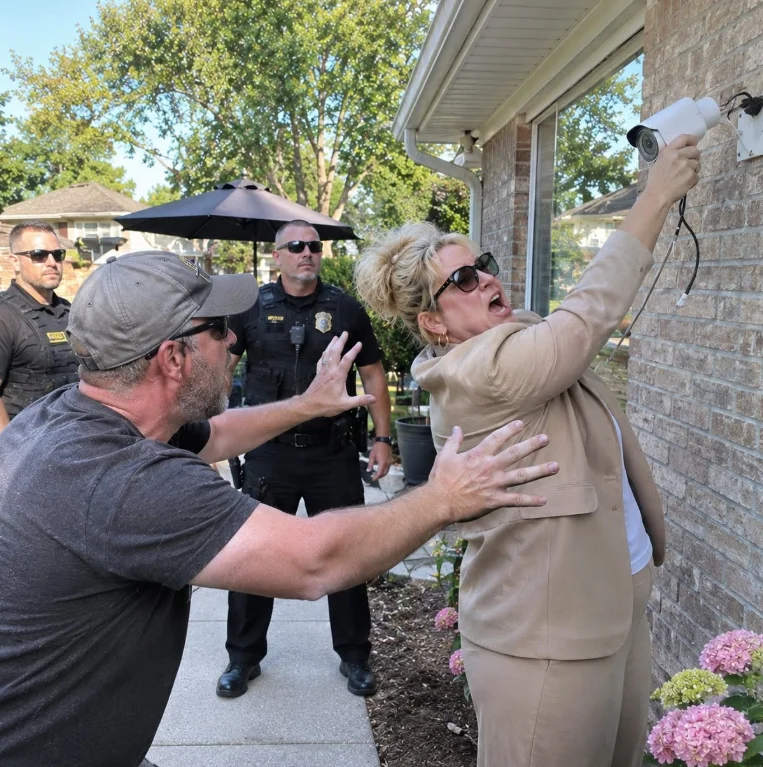
I turned back to the counter, picked up the brand-new Reolink 4K turret camera, and grabbed my cordless hammer drill from the shelf.
“Come on, Doctor,” I said to Dr. Patel. “Let’s go fix a hole in the wall.”
Ten minutes later, I was standing on a four-foot step ladder beneath the eave of my front porch.
The autumn air smelled of crushed cedar mulch and damp earth. Dr. Patel stood at the base of the ladder, holding the hardware bag and passing me the stainless steel masonry screws one by one.
I cleaned out the damaged mortar holes with a stiff wire brush, blew away the red brick dust, and inserted heavy-duty commercial expansion anchors rated for four hundred pounds of shear force.
I stripped the weather-resistant jacket off the Cat-6 cable, punched the eight twisted copper pairs into a fresh RJ-45 modular plug with my crimping tool, and snapped the connector into the camera’s weatherproof terminal until it locked with a satisfying CLICK.
I positioned the heavy aluminum mounting base over the anchors, aligned the leveling bubble, and drove the four stainless screws deep into the brick with the hammer drill.
RAT-TAT-TAT-TAT.
The sound echoed through the cul-de-sac—clean, solid, and permanent.
I attached the camera housing, tightened the anti-tamper Torx screws with an L-wrench, and pointed the wide-angle lens toward the driveway, the front sidewalk, and the public street.
Down on the pavement, Dr. Patel looked up, smiling for the first time all day. “Is it live?”
I pulled my smartphone from my pocket and opened the mobile surveillance app.
The video feed flared onto the screen in glorious, uncompressed 4K resolution. The colors were vibrant, the contrast was sharp, and the frame rate was butter-smooth. In the corner of the frame, the green digital indicator blinked steadily: CAM-02: ONLINE — RECORDING ENCRYPTED.
Through the lens, I could see the whole cul-de-sac: my clean driveway, Mrs. Gable’s blooming marigolds across the street, the empty driveway at 1445, and the wide, open sky stretching out over Whispering Pines.
There were no blind spots left.
Not on my house.
And not in this town.
“She’s live, Doctor,” I said, stepping down from the ladder and folding it shut. “And this time, nobody’s tearing her down.”
Chapter 8 – The Hearing in Courtroom 4B
At 8:45 AM on Friday morning, the polished brass double doors of Courtroom 4B in the County Circuit Courthouse swung open with a muffled, hydraulic hiss.
The courtroom was paneled in dark, solemn walnut that had absorbed seventy years of legal misery, domestic breakdowns, and small-town political reckoning. Sunlight filtered weakly through high, narrow clerestory windows, cutting dusty golden beams through the air before settling on the long mahogany counsel tables.
I sat at the plaintiff’s table, dressed in a sharp navy suit and a white dress shirt, my hands resting calmly on the polished wood.
To my left sat Arthur Pendelton, looking markedly better than he had at the clubhouse, wearing his traditional three-piece tweed suit. Beside him was Dr. Patel, clutching a leather binder filled with clean, notarized accounting exhibits.



