Bradley Cross was not a licensed commercial landscaper. He didn’t own commercial mowers, hydro-seeders, or a fleet of trucks. In fact, county court records showed Bradley had three separate civil judgments against him for unpaid credit card debts and an active lien on his personal pickup truck.
Verdant Crest LLC was a ghost company.
It was a shell entity set up to siphon nearly eighty-five thousand dollars a year directly out of the neighborhood’s reserve funds into the pockets of Renata Cross’s family, while the actual physical mowing was sub-contracted out to independent day-laborers for pennies on the dollar.
That explained everything.
That explained why Renata was so obsessively paranoid about security cameras covering the common areas and the perimeter streets.
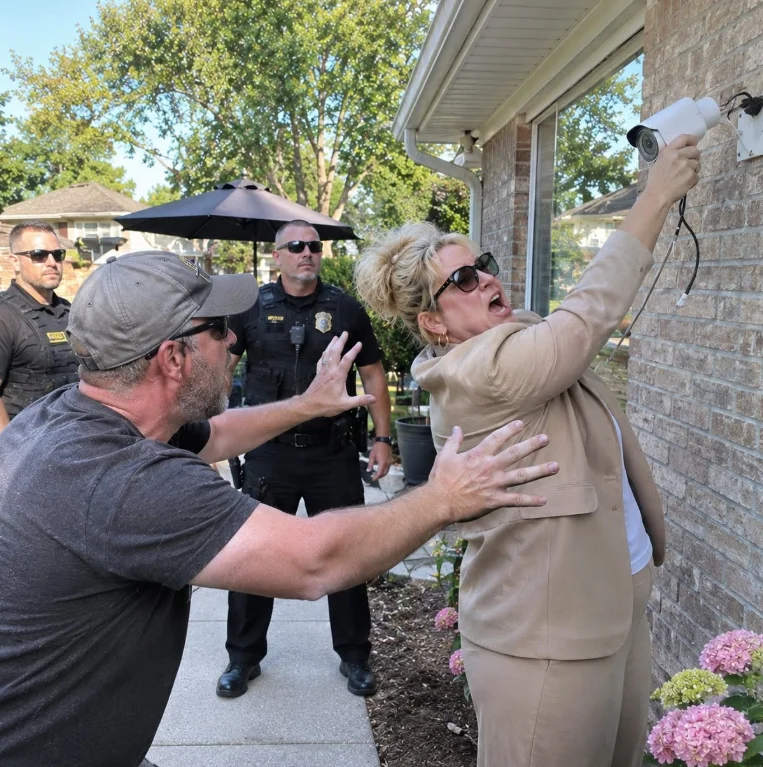
That explained why she had fought with savage, irrational desperation to force me to take down my side and front cameras.
Camera 03 had an unobstructed, wide-angle optical view of the cul-de-sac’s entrance and the adjacent HOA-owned retention pond. Every single Tuesday and Thursday, the maintenance logs filed by Verdant Crest billed the community $1,200 for “Specialized Drainage Clearing and Soil Remediation.”
I opened the video archive for the past three months and pulled up the time-lapse footage for every Tuesday and Thursday morning.
On the footage, no specialized drainage crews ever appeared. No soil remediation equipment ever touched the pond. The only thing that ever happened was a lone, beat-up pickup truck stopping by the retention pond for six minutes while a teenager tossed a bag of grass clippings into the brush before speeding away.
Renata hadn’t just attacked my camera because her suburban pride was bruised.
She had attacked my camera because my network was an unblinking, unbribable digital eyewitness to four years of systematic, six-figure embezzlement.
A soft chime alerted me to movement on the front lawn.
I glanced at the monitors.
It was 4:30 PM.
A sleek, black Mercedes sedan had just pulled into Renata’s driveway. A tall man in an impeccably tailored charcoal suit stepped out of the driver’s seat, carrying a thick leather briefcase. A moment later, Richard Cross opened the front door, looking completely haggard.
Beside the man in the suit walked Renata Cross.
She was out on bail.
Her linen suit was wrinkled, her blonde hair was completely fallen and tangled around her shoulders, and her designer sunglasses were gone, revealing dark, puffy bags under her eyes. But as she stepped out onto her driveway, her posture stiffened. She didn’t look remorseful. She looked like a cornered animal that had just been handed a gun.
The man in the suit was Marcus Vance-Hall—no relation to me, but well-known in the local legal community as an aggressive, predatory civil litigation attorney who specialized in suing municipalities and bullying neighborhood associations.
The three of them stood in the driveway for a tense five minutes, conferring in hurried whispers.
Renata pointed repeatedly across the street at my house, her voice rising in shrill fragments that my garage microphone caught clearly: “…destroy that drive… make him pay… he set me up, Marcus… I want him out of this neighborhood by Friday!”
The lawyer, Marcus, nodded slowly, unzipping his briefcase and pulling out a crisp, white legal envelope. He patted Renata on the shoulder, said something reassuring that made a vicious smirk return to her lips, and then began walking across the asphalt directly toward my front walkway.
I watched him approach on Screen 1.
He was carrying a formal process server’s packet.
I didn’t wait for him to ring the bell. I walked down the stairs, opened the front door, and stood squarely in the frame with my arms crossed over my chest.
Marcus Vance-Hall stopped at the bottom of my porch steps, looking up at me with an oily, confident smile.
“Mr. Victor Vance?” he asked, his voice smooth and dripping with patronizing charm.
“That’s me,” I said.
“My name is Marcus Vance-Hall. I represent Mrs. Renata Cross and the Executive Committee of the Whispering Pines Homeowners Association.” He held out the thick envelope. “You are hereby served with an emergency Cease and Desist order, along with a formal summons for an emergency civil injunction hearing scheduled for tomorrow morning in County Circuit Court.”
I didn’t reach for the envelope. “What’s the cause of action, Marcus?”
The lawyer smiled wider, flashing a row of unnaturally white veneers.
“Unlawful electronic surveillance, voyeurism, harassment, intentional infliction of emotional distress, and violation of the private enjoyment of real property,” he recited smoothly. “My client was subjected to extreme psychological provocation by your illegal recording devices, resulting in an unlawful entrapment event orchestrated by your deliberate placement of hostile equipment. We are seeking an immediate temporary restraining order compelling the total removal of all exterior hardware, forfeiture of all digital media, and five hundred thousand dollars in compensatory and punitive damages.”



