Beside her sat a new court-appointed lead counsel, Jonathan Myers, an experienced former public defender who had taken the appointment with visible reluctance.
Marcus Vance-Hall sat at a separate, isolated table ten feet away, guarded by two county deputies. His law license had been suspended by emergency order of the State Bar disciplinary board forty-eight hours after his arrest. Dressed in standard civilian court attire, he kept his chin buried in his chest, refusing to make eye contact with Renata or anyone in the gallery.
Behind the bar, three rows of spectator benches were filled entirely by the residents of Whispering Pines.
Harold Jenkins sat in the second row beside Mrs. Gable. Harold looked robust, wearing a clean wool coat and holding Mrs. Gable’s hand as she whispered encouragement. Dr. Patel and Arthur Pendelton sat nearby, both holding small spiral notebooks, prepared to testify to the systematic falsification of the association’s minutes and treasury reports.
“Case number CR-2026-4412,” the clerk announced, her voice echoing clearly through the vaulted room. “State of Maryland versus Renata Cross and Marcus Vance-Hall. Indictment charging thirty-two counts, including Racketeering, Conspiracy to Commit Grand Larceny, Wire Fraud, Extortion, and Witness Intimidation.”
Judge Harrison looked down from the bench, his gaze resting upon the defense table.
“Before we proceed to jury selection, Counsel Myers, I understand the defense has an emergency motion to enter into the record?” Judge Harrison asked, his voice low, steady, and devoid of inflection.
Jonathan Myers stood up, adjusting his papers with a weary sigh.
“Yes, Your Honor. At this time, following extensive review of the supplemental forensic digital evidence provided by the state—specifically the uncorrupted server archives and multi-angle surveillance feeds recovered from 1442 Whispering Pines Way—and in light of the federal plea agreements executed yesterday morning by co-conspirators Bradley Cross and Richard Cross, my client wishes to withdraw her plea of not guilty.”
A sharp, collective intake of breath rippled across the gallery.
Renata didn’t turn around. Her shoulders hunched even lower, her forehead nearly touching the tabletop.
Judge Harrison set his pen down, his eyes locking onto Renata like twin gun barrels.
“Mrs. Cross, please rise,” the judge ordered.
Renata struggled to her feet. Her knees wobbled visibly; she had to press both palms against the table to steady herself. Her public defender placed a supportive hand on her elbow, but she shivered, pulling away from his touch as if her skin were raw.
“Mrs. Cross,” Judge Harrison said, his voice ringing through every corner of the silent room. “Your counsel has indicated your intent to tender a negotiated plea of guilty. Before I accept this change of plea, you must understand the constitutional rights you are waiving. You have the right to a trial by a jury of your peers. You have the right to confront the witnesses against you, including Mr. Victor Vance, Mr. Harold Jenkins, and the forensic auditors from the Treasury Department. Do you understand these rights?”
“Yes… Your Honor,” Renata whispered. Her voice was cracked, barely carrying across the microphone on her table.
“Louder, Mrs. Cross, for the court reporter,” Judge Harrison said firmly.
“Yes, Your Honor,” she repeated, her voice trembling violently.
“Has anyone coerced you, threatened you, or promised you anything outside the four corners of this formal plea agreement to induce you to surrender your rights?”
“No, Your Honor.”
Judge Harrison picked up the multi-page plea colloquy document submitted by the Attorney General’s office.
“To Count One: Criminal Racketeering in violation of State Penal Code Section 18-202, in that you did knowingly, willfully, and corruptly operate an enterprise designed to embezzle over one point four million dollars from the Whispering Pines Homeowners Association through fraudulent billing entities, specifically Verdant Crest LLC and Crestline Holdings LLC. How do you plead? Guilty or not guilty?”
Renata’s chest heaved. She looked down at the paper in front of her, then glanced briefly toward the gallery where Harold, Mrs. Gable, and the neighbors she had terrorized for a decade sat in solemn, unified silence.
“Guilty,” she choked out.
“To Count Four: Grand Larceny in Excess of One Hundred Thousand Dollars, regarding the fraudulent foreclosure, unlawful acquisition, and resale of 1410 Whispering Pines Way, depriving Mr. Harold Jenkins of four hundred and twenty-three thousand dollars in lawful equity. How do you plead?”
A single, bitter tear rolled down Renata’s sunken cheek, cutting a path through her cheap foundation.
“Guilty,” she whispered.
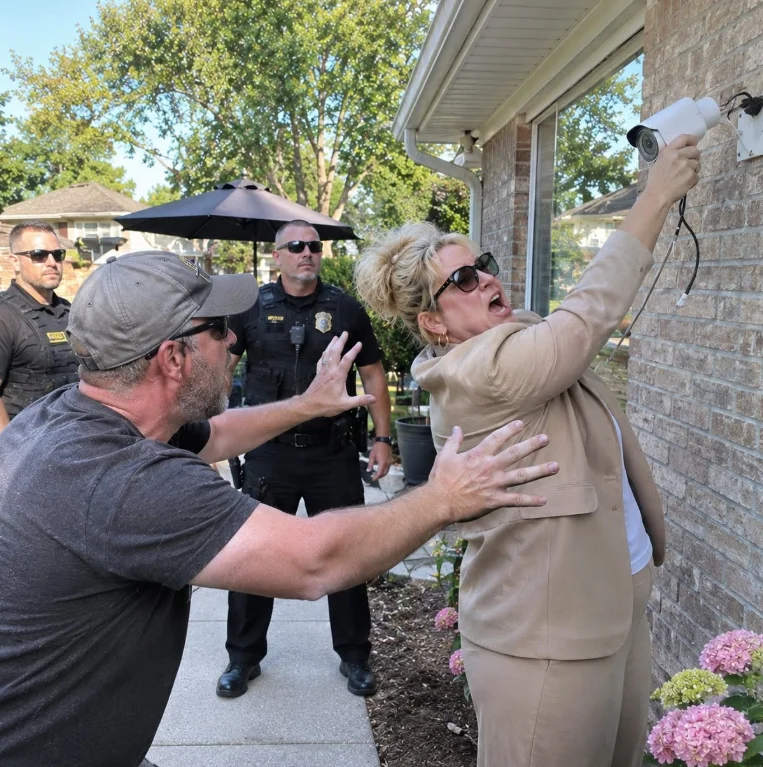
“To Count Eleven: Felony Property Destruction and Tampering with Electronic Surveillance Evidence, regarding the physical destruction of optical surveillance equipment at 1442 Whispering Pines Way on the morning of October 14th. How do you plead?”
Renata closed her eyes, her face twitching with the ghost of that Tuesday morning: the cold air, the snap of the plastic, the severed copper wires, and the realization that another lens had been watching her every move from fifteen feet above.



