“Total transparency,” I confirmed. “If you can’t see where the money is going, someone is stealing it. That’s the first rule of network security, and it’s the first rule of community governance.”
By 3:00 PM, the workers had cleared the rubble from the cul-de-sac entrance. In place of the imposing iron sign, they had planted three young dogwood trees and spread fresh cedar mulch around a simple, tasteful wooden marker that read simply: Whispering Pines — Welcome Home.
I walked back up to my house, feeling the physical fatigue of five days of constant legal and technical warfare finally catching up to my muscles.
I unlocked my front door, stepped into the quiet foyer, and walked up the stairs to my command center.
The four 42-inch monitors were still glowing softly in the dimming afternoon light.
On Screen 1, the new Camera 02 feed was crystal clear. It showed the clean brick facade of my home, the repaired hydrangeas in the flowerbed below, and the wide expanse of the cul-de-sac stretching out to the street.
Through the lens, I watched Harold and Mrs. Gable sitting on the front porch of number 1410. Harold was holding a slice of warm apple pie on a paper plate, laughing at something Mrs. Gable had said. Two young kids on bicycles—children of the Miller family down the block—rode past freely, their laughter carrying through the crisp afternoon air, without fear of their toys being confiscated or their parents being fined.
I looked at Screen 4, which was still displaying the sealed exterior of number 1445.
The grand white house was dark and empty, a silent gravestone to an era of suburban tyranny that would never return.
My email client chimed softly with an alert from the County District Attorney’s Office:
NOTICE OF FORMAL INDICTMENT: STATE V. RENATA CROSS.
Grand Jury returns true bill on thirty-two counts, including Criminal Racketeering, Wire Fraud, Subornation of Perjury, and Grand Larceny.
Formal trial date set for January 12th.
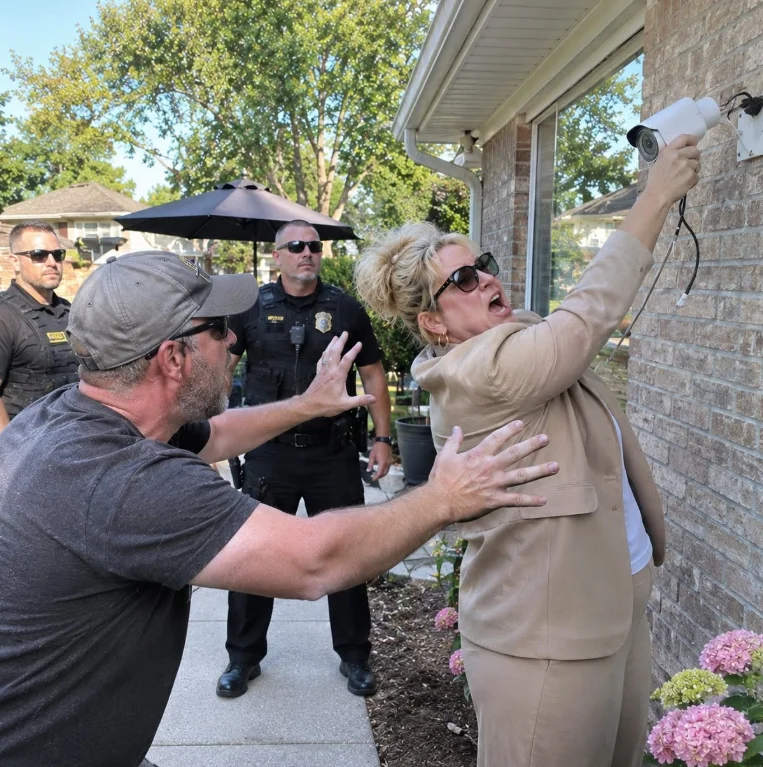
I didn’t open the attachment. I didn’t need to read the legal jargon. Renata’s fate had been sealed the moment she reached up with both hands, let her arrogance blind her judgment, and ripped a piece of plastic off a brick wall.
She had tried to destroy an eye that wouldn’t blink.
Instead, she had forced open the eyes of an entire town.
I reached forward, clicked the mouse, and minimized the legal windows, leaving only the clean, panoramic view of the quiet street on the main screen.
I leaned back in my chair, picked up my fresh mug of coffee, and smiled.
The neighborhood was safe.
The people were whole.
And my system was resting easy.
Chapter 10 – The Retribution of the Court
The County Justice Complex in mid-January was a fortress of gray stone and granite, capped by leaden winter skies that spat occasional flurries of freezing sleet against the high arched windows. Two months had passed since the emergency injunction hearing in Courtroom 4B, but today was different.
Today was the opening of the criminal trial: The State of Maryland v. Renata Cross and Marcus Vance-Hall.
By 8:00 AM, the press gallery on the second floor was already packed with local news vans, their microwave masts extended high above the frozen courthouse plaza. Headlines that had spent eight weeks ricocheting across social media had brought national attention to the quiet suburb of Whispering Pines: “The 4K Karen,” “The Million-Dollar HOA Syndicate,” and “The Sub-Basement of Secrets.”
I walked into Courtroom 1A through the secured side entrance reserved for subpoenaed expert witnesses and victim-advocate representatives. Under my arm, I carried a slim, silver Pelican case containing three write-blocked cryptographic flash arrays, verified with SHA-256 integrity hashes, along with my certified forensic network schematics.
Inside the well of the courtroom, the atmosphere was thick, tense, and heavy as wet cement.
Judge Marcus Harrison sat high upon the bench, flanked by the state and federal flags, his silver-rimmed glasses resting firmly on the bridge of his nose as he reviewed the jury pool sheets. Below him sat the prosecuting team: Senior Assistant Attorney General Deborah Vance-Wells, a sharp-eyed woman with thirty years of financial crimes prosecution under her belt, and Senior Investigator Torres.
At the defense table sat Renata Cross.
The change in her physical appearance over sixty days of detention at the county correctional center was shocking. The woman who had once spent hundreds of dollars every Friday afternoon maintaining an immaculate blonde bouffant was now almost unrecognizable. Her roots had grown out into a stark, uneven gray; her hair was pulled back into a severe, flat bun secured with a cheap plastic clip. She wore an ill-fitting, navy polyester pantsuit purchased from a local department store by her public defender’s office—no designer labels, no gold bracelets, no silk scarves. Her face was gaunt, her skin pale and waxy, and her hands, resting on the defense table, trembled with a constant, nervous palsy.



