“Guilty,” she sobbed.
“And to Count Nineteen: Operating an Unlicensed Extortion Scheme and Subornation of Perjury in connection with the falsification of judicial lien filings in County Circuit Court. How do you plead?”
“Guilty, Your Honor. I plead guilty.”
Judge Harrison signed the document with a heavy, deliberate stroke of his fountain pen.
“The court finds that the defendant understands the nature of the charges, that there is an overwhelming factual and digital basis for the plea, and that the plea is entered knowingly, voluntarily, and intelligently. The plea of guilty is accepted, and a judgment of conviction is hereby entered on all counts.”
Judge Harrison closed the file and turned to the prosecution.
“State, do the victims wish to present victim impact statements prior to the court’s consideration of sentencing recommendations?”
Assistant Attorney General Deborah Vance-Wells rose smoothly. “Yes, Your Honor. We have one statement from the community representative, Mr. Victor Vance, and one statement from Mr. Harold Jenkins.”
“Step forward, gentlemen,” Judge Harrison directed.
I stood up, walked through the swinging wooden gate of the bar, and approached the podium in the center of the courtroom. Harold walked beside me, his steps slow but unhesitating.
I adjusted the microphone and looked directly at Renata Cross.
She wouldn’t look back. She kept her eyes glued to the water glass in front of her, her knuckles white.
“Your Honor,” I began, my voice clear, steady, and carrying the calm precision of an engineer presenting an objective analysis. “When I purchased my home in Whispering Pines, I sought only quiet, safety, and the peace of mind to do my work. What I found instead was an ecosystem governed not by law, but by an unchecked, malignant vanity. For four years, Mrs. Cross operated under the delusion that wealth, social connections, and a brass nameplate conferred upon her the divine right to destroy the lives of those around her.”
I looked across the aisle at the defense table.
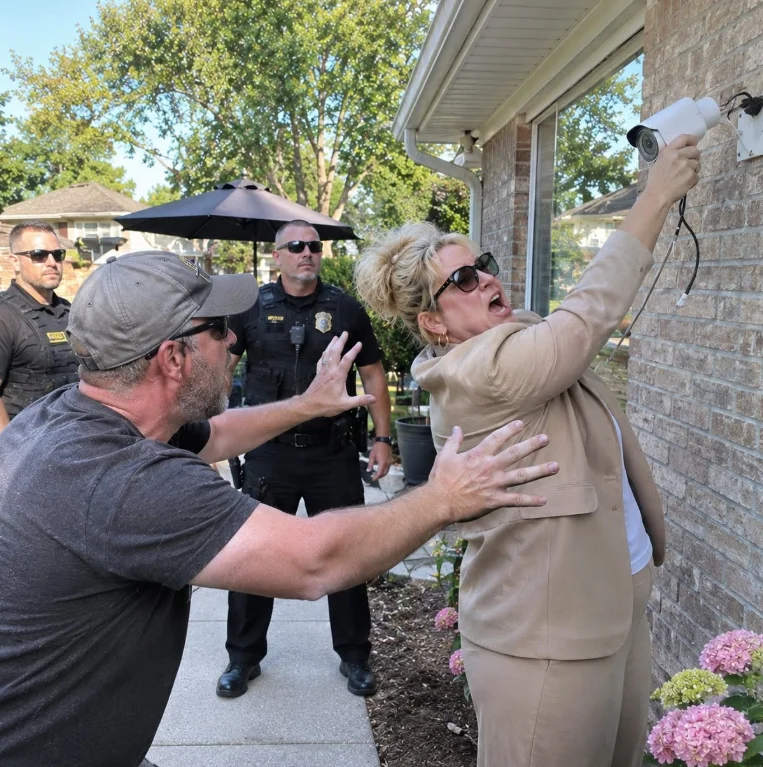
“Mrs. Cross believed that by silencing a camera, she could erase her crimes. She believed that power belongs to those who shout the loudest, threaten the most, and intimidate the vulnerable into compliance. But surveillance in a civil society is not merely about lenses and wires. It is about accountability. It is about the principle that no one, no matter how grand their house or how expensive their suit, is permitted to live above the rules they impose upon others. The network she attacked did not create her guilt; it merely held up a mirror to her soul.”
I stepped back and gently took Harold’s arm, guiding him to the microphone.
Harold adjusted his glasses with a trembling hand, unfolded a small piece of lined notebook paper, and looked up at the bench.
“Your Honor,” Harold said, his voice soft, frail, but ringing with absolute clarity. “Two years ago, when Mrs. Cross took my home, I sat in an emergency room bed with a cracked chest and twenty-four dollars left in my checking account. I thought I had failed my late wife, Mary. I thought that because I was old and couldn’t climb a ladder to paint a wooden railing, I had become worthless to my neighborhood.”
Harold paused, his breath hitching slightly.
“I didn’t care about the money. I cared about the garden Mary and I planted when we were thirty years old. I cared about the memories of my children growing up in that yard. Mrs. Cross didn’t just steal my house; she stole my dignity. She made me feel like an animal being driven into the woods to die.”
Harold turned his head slowly, looking straight at Renata.
“Mrs. Cross, I spent many nights praying for the anger in my heart to go away. And today, sitting here in this courtroom, watching you in that chair… I don’t feel anger anymore. I only feel pity. Because I have my neighbors back, I have my family back, and I have my peace back. But you will spend the rest of your days knowing that you traded your entire soul for a box of cash in a dark basement.”
In the gallery, Mrs. Gable began to weep softly, burying her face in her handkerchief. Even the hardened deputies standing guard along the perimeter shifted their weight, their eyes fixed on the fragile old man at the podium.
Judge Harrison took a deep, slow breath. He removed his glasses, wiped them with a white handkerchief, and replaced them on his nose.
“Thank you, Mr. Jenkins. Thank you, Mr. Vance,” the judge said quietly. “Please be seated.”
We returned to our seats in the front row.
Judge Harrison looked down at Renata Cross, his expression settling into an unyielding, granite mask of judicial finality.



