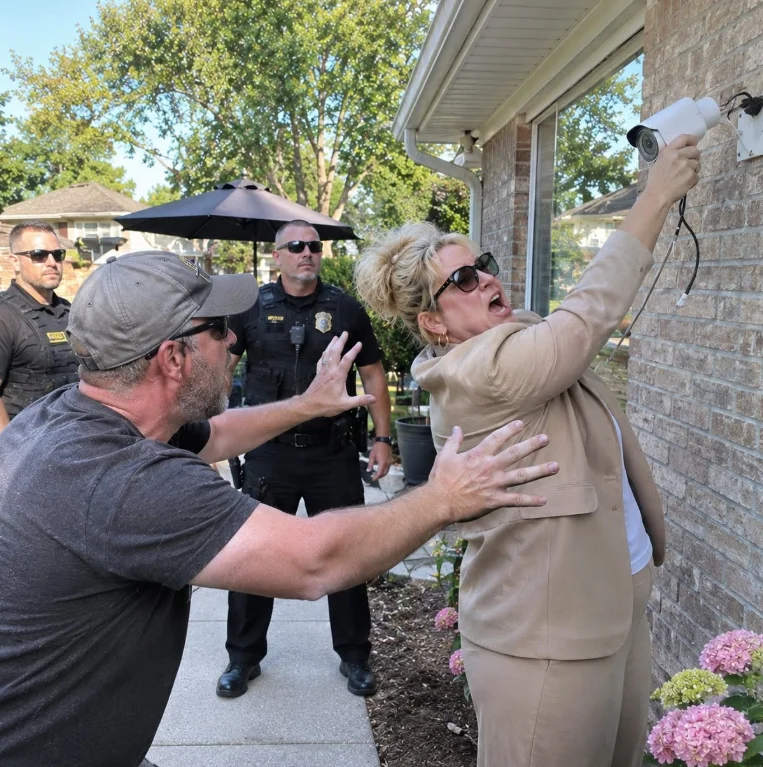
Three days after I mounted the first exterior cameras under my eaves, the first letter arrived.
It was printed on high-grade linen paper with the gold-embossed seal of the Whispering Pines HOA.
Dear Mr. Vance, the letter began, signed in aggressive purple ink by Renata Cross, Vice President. It has come to the attention of the Board that you have installed unauthorized, non-compliant optical recording equipment on the exterior facade of your home. These industrial-style fixtures disrupt the architectural harmony of our community and constitute an intrusive violation of your neighbors’ reasonable expectation of privacy. You are hereby ordered to remove all recording devices within seventy-two hours or face daily escalating fines of $100.
I didn’t panic. I didn’t get angry. I simply opened my PDF copy of the Whispering Pines Declaration of Covenants, Conditions, and Restrictions (CC&Rs)—which I had thoroughly read and annotated before closing on the house.
I wrote a polite, legally precise response. I cited Section 14, Subsection C, which explicitly stated that homeowners had the right to install standard security systems, provided the hardware was painted or matched to the trim and didn’t shine high-intensity floodlights directly into adjacent windows. My cameras were matte-white, exactly matching the vinyl trim of my soffits, and used invisible 940-nanometer infrared night vision.
I sent the letter by certified mail.
Renata didn’t take it well.
Over the next five months, she launched a personal crusade against me. She issued fines for my trash cans being placed two inches too close to the curb. She sent violation notices claiming my driveway was “excessively dirty” after a light rain shower. She even tried to claim that my visitor’s parking spot violated community zoning laws.
Every single time, I appealed the fines to the full board. Every single time, armed with photographic evidence, precise timestamps, and the exact text of the bylaws, I forced the board to dismiss her citations.
Two weeks ago, at the quarterly open meeting in the community clubhouse, Renata had completely lost her composure. In front of forty of our neighbors, she had slammed her leather-bound portfolio onto the folding table, pointed a trembling, scarlet-tipped finger directly at my face, and shrieked that I was a “perverted peeping Tom” who was running an illegal surveillance hub to spy on women and children in their bedrooms.
I had remained seated, calm and relaxed in my jeans and black t-shirt.
I had calmly plugged my iPad into the community projector, displaying a full architectural schematic showing the precise field of view of every single lens on my house. None of them looked into a single window. Every camera was angled strictly at my driveway, my front porch, my property boundaries, and the public street.
The HOA president, an exhausted retired attorney named Arthur Pendelton, had rubbed his temples, banged his gavel, and formally declared: “Mr. Vance’s security system fully complies with all state laws and HOA covenants. This matter is permanently closed. Renata, sit down.”
The look of absolute humiliation that crossed Renata’s face that night was burned into my memory. She had sat there, her chest tightening, her mouth opening and closing like a landed fish, while our neighbors whispered and chuckled behind their hands.
She had cornered me in the parking lot afterward, her voice dropping into a venomous whisper.
“You really think those little plastic toys make you untouchable, Victor?” she had hissed, stepping so close I could smell her stale coffee and expensive perfume. “You think you can embarrass me in front of this neighborhood? You don’t know who I am in this town. You don’t know who my family is.”
“The camera stays, Renata,” I had replied evenly. “Go home.”
And now, fourteen days later, she had finally snapped.
She had decided that if the rules couldn’t save her pride, physical force would.
A sharp, authoritative knock at my front door broke the silence of the house.
I glanced at Screen 3, which displayed the live feed from my front doorbell camera. Standing on my porch was a tall, broad-shouldered man wearing the dark tactical uniform of the county sheriff’s department. His gold badge gleamed in the morning sun: DEPUTY CARL RAYS.
Behind him, parked along the curb, was a black-and-white cruiser with its engine idling.
I stood up, smoothed out my t-shirt, and walked downstairs to let justice in.
“Morning, Deputy,” I said, opening the door with a welcoming smile.
Deputy Rays touched the brim of his cap. He had sharp, observant blue eyes, weathered skin, and an expression that suggested he had spent twenty years dealing with suburban nonsense and was already tired of it.
“Mr. Vance? Dispatch said you called in an active property damage complaint?”



