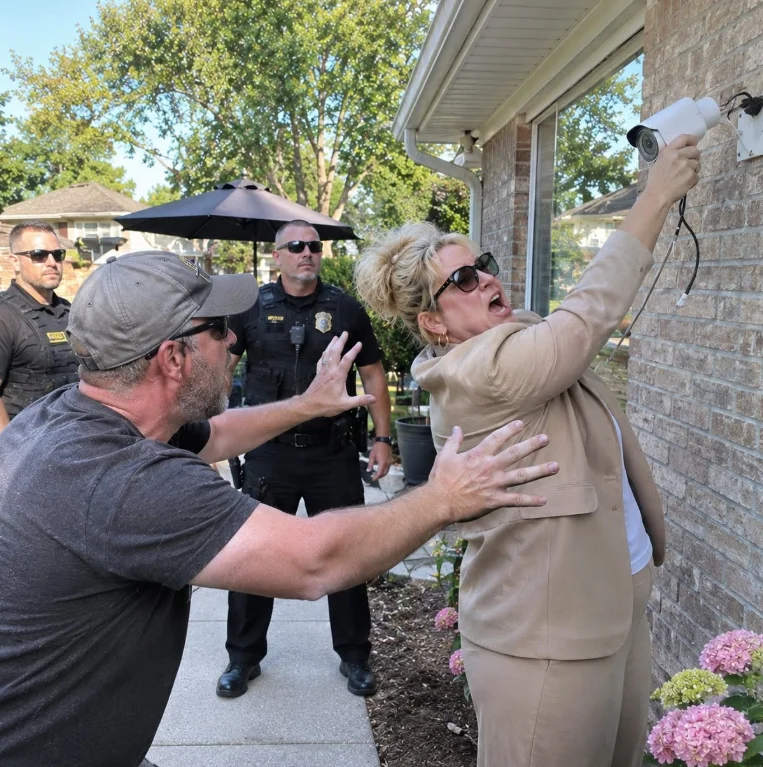
I took out my phone, snapped four high-resolution photos of the landscaping damage, and noted it in my incident log: Additional property damage: Two mature Nikko Blue Hydrangeas, estimated professional replacement value: $240.00.
By noon, Whispering Pines was a buzzing hornets’ nest.
Suburban neighborhoods thrive on gossip, but an arrest of this magnitude was thermonuclear. In a community where a faded mailbox could trigger a three-week email chain, the sight of the HOA Vice President being thrown into the back of a police cruiser in broad daylight was the biggest event since the development had been built in 1998.
I didn’t have to leave my house to know what was happening.
Through Camera 03, which captured the long view of the cul-de-sac, I watched neighbors gather in small clusters at the end of driveways. Mrs. Gable from 1438 was practically vibrating with excitement, waving her arms and reenacting Renata’s screeching arrest for a group of three other homeowners. Cars from other streets in the subdivision—people who had never driven down our quiet lane in six months—began creeping past slowly, their drivers craning their necks to gawk at the empty space on my brick wall and then at the shuttered windows of the Cross residence.
At 1:15 PM, my phone chimed with an incoming email.
It wasn’t from the police. It wasn’t from Richard.
It was an official notice sent from the Whispering Pines Board of Directors portal, bearing the digital signature of Arthur Pendelton, the HOA President:
EMERGENCY NOTICE: SPECIAL BOARD MEETING CONVENED.
Date: Tomorrow, Wednesday, 7:00 PM.
Location: Community Clubhouse Main Hall.
Agenda: Neighborhood Security Infrastructure, Code Compliance Disputes, and Review of Executive Board Conduct.
All residents are strongly urged to attend.
Arthur Pendelton was trying to contain the blast radius. He was a retired corporate litigator who had spent thirty years burying corporate scandals under non-disclosure agreements, and he knew that having an active executive officer arrested for grand larceny on neighborhood grounds was an existential threat to the HOA’s legal standing.
I sat back in my chair, steepled my fingers, and smiled.
“Let’s see what else you’re hiding, Renata,” I murmured.
As an engineer specializing in industrial networks, my job didn’t just involve laying cable and mounting cameras; it involved forensics. When large corporations suffered data breaches or internal theft, my team was the one they brought in to trace the digital breadcrumbs. We knew how to look through public records, corporate filings, municipal permits, and financial disclosures to find the bodies people thought they had buried.
If Renata Cross wanted to turn my life into a legal war zone, I was more than happy to show her what total information dominance looked like.
I opened a fresh terminal window on my secondary monitor and initiated a comprehensive public records search on Renata Cross and the Whispering Pines Homeowners Association.
In this state, HOAs are registered as non-profit corporate entities with the Secretary of State. That meant their annual tax filings, balance sheets, and vendor contracts were legally accessible public records, provided you knew which databases to query and which municipal registries to cross-reference.
For the next three hours, the only sound in my office was the steady clicking of my mouse and the hum of my liquid-cooled server rack.
What I found in those records wasn’t just surprising—it was explosive.
Over the past four years, the Whispering Pines HOA had collected over $480,000 in annual dues and an astonishing $112,000 in disciplinary fines. But when I pulled the vendor expense reports, a glaring anomaly jumped out immediately.
Under the line item for “Grounds Maintenance and Landscaping Infrastructure,” the HOA had paid $84,000 annually to a company named Verdant Crest Property Solutions LLC.
I ran the corporate registration number for Verdant Crest through the state business portal.
The company had been formed four years ago.
Its registered business address was a P.O. Box in a strip mall twelve miles away.
And its sole managing member and registered agent was a man named Bradley Cross—Renata and Richard Cross’s twenty-eight-year-old son.
I leaned closer to the screen, my heart beating with cold, methodical excitement.
I pulled up the Whispering Pines HOA bylaws and searched for Section 9: Conflicts of Interest and Competitive Bidding.
The bylaws explicitly stated: No officer or director shall enter into, negotiate, or approve any contract for services with any entity in which said officer, director, or immediate family member holds a direct or indirect financial interest, without unanimous written disclosure to the general membership and a competitive bidding process involving at least three independent commercial bids.
There had never been a competitive bidding process. There had never been a disclosure.
I dug deeper into the county court records and municipal tax archives.



