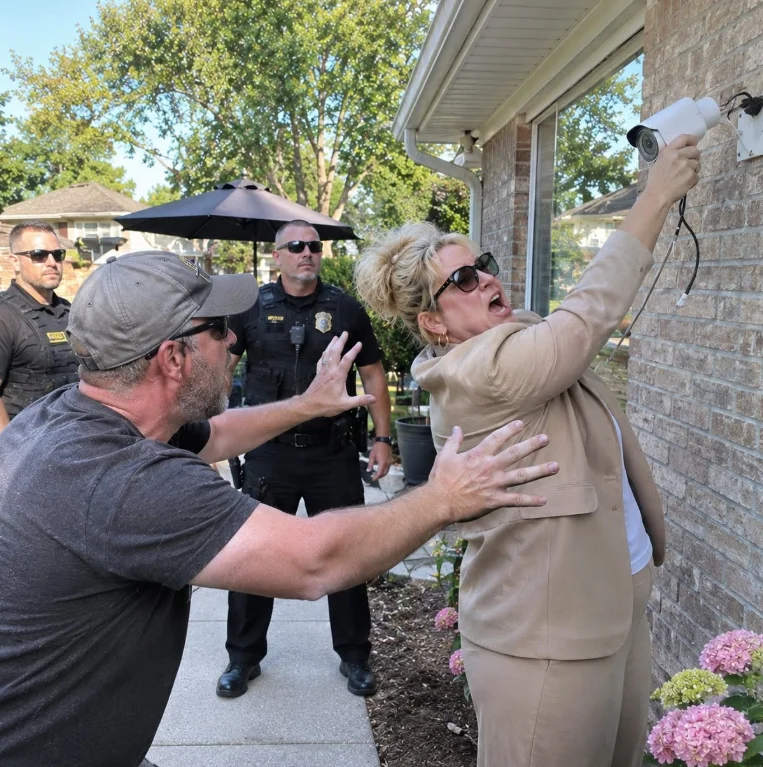
“Hi, my name is Victor Vance. I live at 1442 Whispering Pines Way,” I said, my voice steady, measured, and completely devoid of panic. “I am calling to report an active incident of trespassing, vandalism, and property destruction currently in progress at my residence.”
“Is anyone injured, sir? Is the perpetrator still on the scene?”
“No injuries,” I replied. “The perpetrator is my neighbor, Renata Cross, who also happens to be the vice president of the local Homeowners Association. She just crossed onto my private property, ripped a hardwired commercial security camera off the exterior brick wall of my home, and is currently walking back across the street to her house at 1445 Whispering Pines Way with the stolen hardware in her hands.”
There was a brief pause on the other end of the line. Suburban dispatchers dealt with barking dogs, noise complaints, and teenage joyrides all day, but an HOA vice president physically ripping equipment off a house in broad daylight was rare.
“Did you witness this in person, Mr. Vance?”
“I witnessed it live on a redundant optical feed from my home office, and I have the entire incident captured from multiple high-definition angles with synchronized audio and uncorrupted timestamps. I am currently saving the raw master files.”
“Officers are in the area,” the dispatcher said, typing audibly. “A deputy has been dispatched to your location. Please remain inside your residence and do not confront the suspect.”
“Understood. I have no intention of leaving my desk.”
I hung up, placed the receiver in its cradle, and went to work.
With practiced efficiency, I used my mouse to isolate the clip. I created a dedicated directory on my local drive: INCIDENT_CROSS_RENATA_0651.
I exported the Camera 01 footage: a wide, cinematic angle showing Renata walking deliberately across the asphalt of the cul-de-sac, marching past my property line markers, stepping deep into my garden, and glaring up at the lens with cold premeditation.
Then, I exported the last three seconds of Camera 02: the close-up shot of her face as she lunged upward. In that shot, you could see the fine wrinkles around her eyes, the brand logo on the corner of her sunglasses, the flare of her nostrils, and the sheer malice twisted across her features right before her hands gripped the white metal housing and yanked it downward. The screen violently jolted, capturing the sky, the brick, the manicured fingernails, and then—pure black.
Together, the two camera angles told an airtight, undeniable story. There was no defense of an accident. There was no claim of self-defense. There was no plausible deniability. It was willful, intentional, malicious destruction of private property.
And knowing Whispering Pines, this wasn’t just about an ugly camera.
This feud had been brewing for six long months.
Whispering Pines was one of those affluent, gated suburban developments where people bought half-million-dollar houses just to obsess over the color of their neighbor’s window shutters. The HOA rules were bound in a three-ring binder thicker than the county tax code. You couldn’t park your car in your own driveway for more than forty-eight consecutive hours. You couldn’t leave your garbage cans out past 6:00 PM on collection day. You couldn’t paint your front door any color that wasn’t approved by the Architectural Review Committee—which really just meant approved by Renata Cross.
For over a decade, Renata had ruled this development like an absolute monarch. Her husband, Richard, was a meek, retired accountant who spent all his waking hours either golfing or pretending to be deaf whenever Renata started screeching about unraked leaves. Because most of the residents were elderly retirees or busy corporate executives who traveled during the week, nobody ever showed up to the monthly HOA meetings.
Renata took that apathy as a mandate for absolute control. She patrolled the sidewalks every single evening with a clipboard, measuring grass height with a literal wooden ruler and photographing oil spots on concrete with her iPad. If your Bermuda grass was three-sixteenths of an inch above the four-inch limit, a fifty-dollar fine notice would be taped to your door by 8:00 AM the following morning.
When I bought the house at 1442, the property had been sitting vacant for nearly two years. The previous owner, an elderly widower named Harold, had practically been driven into an assisted living facility by Renata’s relentless fines over his overgrown azalea bushes.
The house was solid, well-built, and situated at the very end of a quiet cul-de-sac. As a remote engineer who prized peace and privacy, it seemed ideal.
The trouble began the second week after I moved in.
I had hired a contractor to install modern fiber-optic cabling and had spent my weekends setting up my security infrastructure. Due to the high-value equipment I maintained for my contracting business, adequate surveillance wasn’t an aesthetic choice; it was an insurance requirement.



